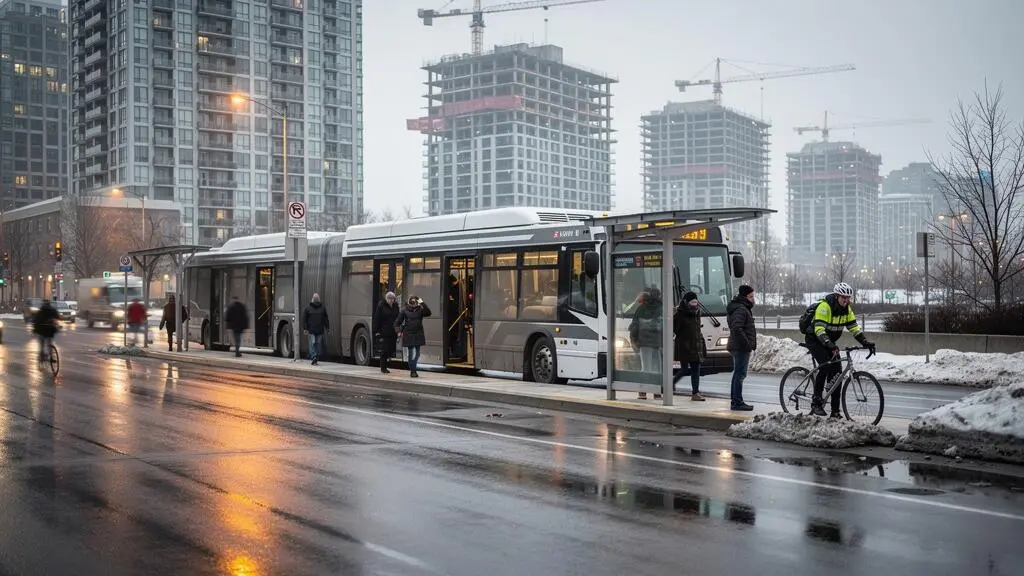
Public transit expansion delivers its greatest benefits where it connects substantial travel demand with reliable service, accessible stations and destinations people need to reach. In Canadian cities, that often means upgrading overcrowded corridors, improving connections between residential neighbourhoods and major employment centres, or establishing dependable transit before fast-growing suburbs become dependent on cars.
But building additional kilometres of track or bus lanes does not automatically produce shorter commutes, fewer cars or stronger local economies. The benefits depend on who can use the service, how much time it saves, whether it operates reliably and how surrounding land develops.
According to Statistics Canada’s 2025 commuting statistics, 80.9% of Canadian commuters primarily travelled by car, truck or van in May 2025, while 11.9% primarily used public transit. That difference illustrates the scale of automobile dependence, although national mode shares cannot identify which individual investments would deliver the strongest returns.
For residents and planners, the useful question is therefore not simply where transit can expand, but where a specific investment can improve door-to-door mobility, access to opportunity and long-term urban capacity.
Where transit expansion creates the most value
- Busy, constrained corridors: Dedicated transit infrastructure can improve reliability and passenger capacity where existing buses already experience delays or crowding.
- Connected, walkable destinations: Stations serving jobs, housing and essential services generate more useful access when walking, cycling and feeder connections work.
- Growing neighbourhoods with coordinated investment: Early high-quality service can support transit-oriented development when land use, local infrastructure and operating funding are aligned.
- Why Doesn’t New Transit Always Convince Drivers to Switch?
- How Can Cities Identify the Best Corridors for Transit Expansion?
- Bus Rapid Transit or Rail: Which Fits a Growing Canadian Corridor?
- Why Can Poor First-Mile Access Undermine a Major Transit Investment?
- When Should a Busy Transit Route Receive a Major Capacity Upgrade?
- How Can Cities Add Density Without Overloading Local Services?
- Upgrade or Expand: Which Infrastructure Strategy Fits Fast-Growing Areas?
- Which Infrastructure Investments Matter Most for Canada’s Long-Term Growth?
Why Doesn’t New Transit Always Convince Drivers to Switch?
New transit does not automatically attract drivers because people compare complete journeys, not merely the availability of a nearby bus or train. A service must offer a practical combination of travel time, reliability, cost and convenience to compete with driving. If reaching the station, waiting and transferring make the trip less attractive, additional infrastructure may produce limited mode switching.
Transport planners describe these competing factors through generalized travel cost. This includes time spent walking, waiting, travelling and transferring, alongside fares, parking costs, uncertainty and personal convenience. A station close to someone’s home may offer little benefit if the service travels away from their workplace or requires an unreliable connection.
National commute figures illustrate why this distinction matters. Statistics Canada reported average journeys of 44.1 minutes for public transit commuters and 24.7 minutes for car commuters in May 2025. These figures describe different populations and journeys; they do not prove that driving is faster on any particular corridor.
Consider a hypothetical suburban commuter travelling to downtown Toronto. Driving may remain attractive when workplace parking is inexpensive and the destination is difficult to reach from a rail station. But a frequent GO Transit connection with dependable travel times and expensive downtown parking could change the comparison, particularly when the commuter can reach the departure station without a burdensome detour.
Car ownership creates another obstacle. Households that already own vehicles may focus on the immediate expense of fuel and parking rather than the full cost of ownership. Transit fares must therefore be assessed against the costs commuters actually perceive, not just an abstract comparison of annual expenditures.
Off-peak usefulness matters as well. A new peak-hour service might suit a conventional office commute while remaining impractical for evening shifts, childcare trips or weekend activities. Infrequent feeder buses and missed connections can further discourage people from changing established travel habits.
There is also a distinction between increasing transit ridership and reducing visible road congestion. When drivers shift to transit, freed road capacity may attract other vehicle trips. Consequently, transit can increase the number of people moving through a corridor without producing an equivalent or lasting reduction in traffic delays.
A convincing expansion proposal should explain whose journeys improve, at what times and by how much. Those differences are the foundation for selecting corridors that deserve investment.
How Can Cities Identify the Best Corridors for Transit Expansion?
Cities can identify promising transit corridors by comparing existing passenger demand, concentrations of jobs and essential services, travel-time disadvantages and opportunities to provide dedicated right-of-way. The strongest candidate depends on the investment objective: maximizing ridership, improving access for underserved residents or preparing for future growth. A transparent evaluation should distinguish these goals before ranking projects.
Four questions form a practical starting point:
- Who already travels there? Examine passenger boardings, peak loads, population concentrations and patterns of travel between origins and destinations.
- What destinations are connected? Identify employment districts, hospitals, universities, schools and major transfer points at both ends and along the corridor.
- How competitive is the existing service? Compare complete transit journeys with driving, including congestion, waiting, transfers and variability.
- Can service become more reliable? Assess street space, intersections, potential bus lanes, station locations and physical constraints.
Vancouver’s Broadway corridor demonstrates why established demand is valuable evidence. TransLink’s 2023 Bus Speed and Reliability Report corridor profiles documented more than 29,000 weekday boardings on the 99 B-Line during the historical reporting period. The corridor also connects important destinations associated with the University of British Columbia, Vancouver General Hospital and Vancouver City Hall.
Vancouver’s Broadway corridor: demand and delay in the same place
TransLink’s historical assessment covered 13.1 kilometres of Broadway and identified very frequent peak-period bus service, substantial passenger activity and congestion-related delays.
The report estimated 1,750 person-hours of daily passenger delay and identified potential improvements involving bus lanes, signals and stops. Construction affected the observed operating conditions, so these findings should not be treated as an unchanged description of the corridor in 2026.
A heavily used corridor offers a clearer demand baseline than a proposed route through an undeveloped area. However, that does not automatically make upgrading it the best public investment. Extending access to a neighbourhood without adequate transit can have substantial equity benefits even if projected boardings per kilometre are lower.
Ottawa’s Transitway experience also illustrates the strategic importance of dedicated corridors and the possibility of adapting parts of a transit network as demand and operating requirements evolve. The lesson is to evaluate long-term capacity alongside immediate service improvements, not to assume that every bus corridor should eventually become rail.
Residents can test the quality of a business case by examining projected riders per kilometre, capital and operating costs per passenger, expected travel-time savings and sensitivity to slower population growth. Forecasts should disclose assumptions about housing, employment, fares and connecting services.
Five checks for evaluating a proposed transit corridor
- Map existing travel demand: Produce a corridor map identifying busy routes, major origins and destinations, and current transfer locations.
- Compare realistic journey times: Create a door-to-door comparison for representative trips during peak and off-peak periods.
- Identify the service bottleneck: Prepare a short inventory of crowding, traffic delays, missed connections and right-of-way constraints.
- Separate project objectives: Build a scorecard showing how the corridor performs on ridership, accessibility, equity and growth readiness.
- Review forecast uncertainty: Summarize business-case assumptions and identify which projected benefits depend on future development or service funding.
Once a corridor’s purpose and demand are understood, the next decision is which transit technology can deliver the necessary capacity without committing the city to unnecessary cost.
Bus Rapid Transit or Rail: Which Fits a Growing Canadian Corridor?
Bus rapid transit generally suits corridors where cities need substantial service improvements, flexible operations and lower initial infrastructure commitments. Rail becomes more attractive when sustained demand requires larger vehicles, highly reliable service and durable capacity over many decades. Neither mode is automatically superior: corridor demand, right-of-way design, operating costs and long-term land use determine the appropriate choice.
A meaningful comparison must distinguish full bus rapid transit (BRT), with dedicated lanes and efficient stations, from ordinary buses receiving limited priority measures. Likewise, rail proposals differ considerably between surface light rail, grade-separated light rail and metro systems.
The table summarizes typical planning trade-offs rather than presenting universal cost or capacity rankings.
| Evaluation factor | Bus rapid transit | Rail transit |
|---|---|---|
| Passenger capacity | Expandable through larger buses, higher frequency and station design; constrained by bus traffic and boarding operations at high volumes | Higher-capacity options available through longer trains, larger vehicles and dedicated infrastructure |
| Capital investment | Often lower initially, particularly when existing road corridors can be adapted | Often higher because of track, power, specialized structures and related systems |
| Operating cost per passenger | Competitive at moderate demand; labour and vehicle requirements increase with frequency | Potentially favourable at high ridership because one train can carry many passengers |
| Speed and reliability | Strong with protected lanes, effective stations and intersection priority | Strong with dedicated alignment; surface rail can still face intersection delays |
| Route flexibility | Can support branching routes and service adjustments | Fixed tracks provide stability but make route changes costly |
| Future upgrades | Can be designed to preserve a rail conversion option | Can expand through longer trains, increased frequency or infrastructure upgrades |
For a growing Canadian corridor, the phasing decision can matter as much as the initial mode. A properly designed BRT corridor may preserve sufficient space and suitable geometry for a future rail conversion. Poorly located stations, constrained structures or incompatible street layouts can make conversion disruptive and expensive.
Rail can also provide a strong, visible signal of long-term infrastructure commitment to developers. Yet development around stations depends on zoning, housing approvals, market conditions, pedestrian access and complementary services. Fixed tracks alone do not guarantee investment or higher ridership.
Financial feasibility adds another layer. Canadian projects depend on how capital costs, operating responsibilities, procurement risks and funding commitments are divided among municipal, provincial and federal governments. A technically attractive option may not be deliverable within an available funding arrangement.
The appropriate business case should therefore test multiple demand scenarios, full lifecycle costs, disruption during construction and the cost of adapting the corridor later.
Whatever the mode, its practical usefulness depends on how easily passengers can reach the stations. That frequently overlooked factor can undermine even a well-chosen investment.
Why Can Poor First-Mile Access Undermine a Major Transit Investment?
Poor first-mile access reduces transit investment benefits because a station only serves people who can reach it conveniently and safely. Wide roads, disconnected sidewalks, difficult cycling routes and infrequent feeder buses can turn a nearby station into an inconvenient destination. Consequently, the population effectively served may be substantially smaller than a simple radius on a planning map suggests.
A station’s theoretical catchment is commonly represented by the area within a specified distance. But straight-line distance conceals barriers: a person living close to a platform may have to make a long detour to cross an arterial road or reach the only available entrance.
Access also involves time rather than distance alone. Walking, cycling and feeder travel add to the complete journey, as do waiting, weather exposure and uncertain transfers. As access becomes more difficult, fewer potential passengers are likely to consider transit competitive. The relationship is context-dependent; it should not be assigned a universal exponential decay rate without local evidence.
Park-and-ride facilities present a genuine trade-off. They can extend station access to drivers from areas with limited transit connections, but large surface parking lots can occupy land that might otherwise accommodate homes, workplaces and pedestrian-oriented development.
Canada’s 2025 federal sustainable development progress report stated that more than three-quarters of Canadians lived within 500 metres of a transit stop. That geographic measure is useful, but it does not establish how frequently vehicles arrive, whether the routes serve useful destinations or how easily people can reach them.
Station-area integration is especially important in suburban networks. Montréal’s Réseau express métropolitain (REM) raises practical questions about how connecting buses, pedestrian approaches and station access should work together. Vancouver’s SkyTrain network likewise illustrates the importance of local walking and cycling connections to a regional rapid transit system. These are planning considerations, not evidence here that every station in either system has succeeded or failed.
When assessing a proposed station, residents should examine sidewalk continuity, safe crossings, protected cycling approaches, bicycle parking, feeder-bus frequency and transfer arrangements. Winter maintenance and accessibility for people using mobility devices also influence whether these connections remain usable throughout the year.
Sequencing is critical. If a rapid transit station opens before surrounding crossings, bus connections or accessible pathways are completed, its initial usefulness may fall short of expectations. Building the access network alongside the main project can reduce that risk.
Good access allows the infrastructure to serve its intended market. Once ridership grows, however, planners must also recognize when the existing route is approaching its operational limits.
When Should a Busy Transit Route Receive a Major Capacity Upgrade?
A busy transit route should receive a major capacity upgrade when recurring overcrowding, passenger pass-ups and unreliable travel times persist despite reasonable operational improvements. The strongest case emerges when additional buses no longer solve the problem efficiently and dedicated infrastructure would improve both passenger throughput and service reliability. The decision must also account for expected future demand.
Overcrowding is more than an uncomfortable passenger experience. As vehicles fill, boarding and alighting can take longer, increasing time spent at stops. A delayed bus may then encounter more waiting passengers while a following bus catches up, producing uneven intervals and further delays.
This cascading reliability problem means that nominal frequency does not always translate into dependable capacity. A route advertised as frequent may still leave passengers facing irregular departures and unpredictable waits.
Before recommending rail or a completely rebuilt corridor, agencies should evaluate an escalation of interventions:
- Increase service frequency when vehicle availability, street capacity and operating budgets permit.
- Introduce larger vehicles, such as articulated buses, where route geometry, stations and maintenance facilities support them.
- Reduce boarding delays through suitable fare collection arrangements, all-door boarding and stop improvements.
- Prioritize transit in traffic using bus lanes, intersection treatments and signal priority.
- Invest in full BRT or rail when forecast demand and persistent constraints justify dedicated higher-capacity infrastructure.
Each measure has limits. More frequent buses increase operating requirements and can worsen congestion at stops or intersections. Larger vehicles offer additional space but cannot eliminate traffic delays. Signal priority helps at some bottlenecks without replacing continuous protected right-of-way where congestion is severe.
A capacity assessment should examine sustained peak loads, how often vehicles leave passengers behind, passenger delays and the operational cost of delivering reliable frequency. One exceptionally busy day is insufficient evidence for a permanent capital upgrade.
Planners must also avoid designing exclusively for current demand. Faster, more reliable service can attract additional passengers, especially where improved connections make transit viable for previously impractical journeys. Without room for that response, an expensive upgrade may become constrained sooner than expected.
Capacity investments perform best when surrounding development reinforces ridership without creating new shortages in schools, utilities and other neighbourhood services.
How Can Cities Add Density Without Overloading Local Services?
Cities can add density without overwhelming local services by coordinating housing approvals with transit capacity, water and sewer upgrades, schools, parks and community facilities. Higher density can improve transit viability, but only if the infrastructure supporting additional residents is delivered at the right time. The central challenge is aligning development, capital funding and operating budgets.
Transit-oriented development can place more households within easy reach of rapid transit, increasing potential ridership without extending the network across large distances. However, a neighbourhood needs much more than transportation.
Additional housing can increase demand for classrooms, recreational space, childcare, emergency services and utility connections. Some systems may have unused capacity, while others require significant investment before new residents arrive. The result depends on local conditions rather than density alone.
Infrastructure sequencing is therefore essential. A municipality might approve apartment buildings near a station while school construction, sewer upgrades or park acquisition follow different funding and approval timelines. That mismatch can create local service pressure and weaken support for further intensification.
Financing is another constraint. Development charges, where applicable, can contribute to growth-related infrastructure, but revenue timing, eligible costs, exemptions and local rules influence what they actually cover. Property-tax revenue may rise as development occurs, yet ongoing operating costs can rise as well.
Other approaches, including land-value capture mechanisms and negotiated development contributions where permitted, may help finance improvements. Their feasibility depends on provincial legislation, municipal policy, market conditions and the specific costs involved. Increased property values near transit are not themselves proof that sufficient public revenue will be collected.
The form of density also matters. Mixed-use corridors with housing, shops and employment can support trips throughout the day. Gradual intensification can distribute growth across multiple stations, while isolated large developments may concentrate demand on particular streets and facilities.
Housing mix should be part of the evaluation. Projects with limited family-sized accommodation and few neighbourhood services may produce a very different pattern of demand from developments designed for varied household types and everyday activities.
A useful planning test is whether the city has identified the infrastructure required, the organization responsible for it, a credible funding mechanism and an implementation schedule linked to occupancy.
These constraints influence whether a city should concentrate resources on its existing urban network or extend infrastructure into new growth areas.
Upgrade or Expand: Which Infrastructure Strategy Fits Fast-Growing Areas?
Upgrading existing infrastructure is often preferable where demand is established and congestion or capacity constraints already limit mobility. Expansion can be more valuable where a growing area can develop around reliable transit before automobile dependence becomes entrenched. Fast-growing Canadian cities frequently need both approaches, but their timing and balance should reflect projected development, network capacity and available funding.
Upgrades and expansion address different problems. An upgrade increases the quality or capacity of infrastructure already serving people. Expansion brings service to additional destinations and potential users.
Neither strategy should be judged by route length alone. A short improvement serving a crowded corridor may deliver substantial daily benefits. A longer extension could create opportunities for new housing and employment, but those benefits depend on whether enough development and service demand emerge.
Three variables can help cities decide:
- Growth readiness: Can the new area realistically accommodate sufficient housing, employment and mixed uses to support effective transit?
- Existing network capacity: Can the current system accommodate additional passengers, or must core routes and interchange stations be upgraded first?
- Funding completeness: Can the proposed investment provide useful frequency, reliable infrastructure, access improvements and sustainable operations rather than a thin extension of an already weak service?
Consider two hypothetical scenarios. In the first, an established bus corridor has persistent delays and crowded vehicles. Dedicated lanes could improve journeys for existing passengers immediately. In the second, a suburban district is planned for substantial housing growth but lacks a dependable transit connection. Establishing a high-quality spine early could influence travel choices as residents move in.
Both projects may be reasonable, but their risks differ. The existing corridor upgrade could increase pressure on nearby housing markets or shift crowding to connecting routes. The expansion could attract too few passengers if approved land uses, development schedules or connecting services fail to materialize.
Canadian transit planning offers a further lesson: infrastructure systems change over time. Vancouver’s high-demand bus corridors and Ottawa’s staged transit network development illustrate different reasons to preserve flexibility, though their particular outcomes cannot establish a universal preference for either strategy.
A combined approach may involve improving a constrained network backbone while reserving and building transit-ready corridors in growing suburbs. This requires long-term coordination across municipal planning, transit operations, development approvals and successive funding decisions.
The broader question is how these choices contribute to Canada’s long-term economic capacity, particularly when transit competes with other essential infrastructure for limited public resources.
Key takeaways for investment decisions
- Measure improved access to jobs and services, not simply new infrastructure length or forecast boardings.
- Evaluate transit together with housing-enabling utilities, local facilities and the funding needed to operate the complete system.
- Preserve flexibility: corridors that support changing demand and future upgrades are generally more resilient than projects built around a single optimistic forecast.
Which Infrastructure Investments Matter Most for Canada’s Long-Term Growth?
Canada’s most valuable infrastructure investments are those that remove binding constraints on economic activity, housing and access to opportunity. Transit expansion can be particularly important in congested metropolitan corridors where it connects people to jobs and supports more efficient land use. Elsewhere, housing-related utilities, electricity systems, roads or digital connectivity may address more urgent limitations.
Public transit contributes to economic performance through several interconnected mechanisms. Reliable mobility can enlarge the labour market available to employers, improve workers’ access to suitable jobs and reduce the space required to move large numbers of people through urban centres.
Transit also supports agglomeration: the potential advantages businesses and workers gain from being able to interact within accessible urban areas. These effects depend on local economic structure, development patterns and actual changes in accessibility. They cannot be assumed from the construction of a new line alone.
Access to jobs provides a particularly useful common measure. Instead of asking only how many kilometres of transit are added, planners can estimate how many employment opportunities residents can reach within a defined door-to-door travel-time threshold.
The same approach can reveal distributional differences. A project might significantly improve employment access for households without cars while producing smaller benefits for residents already served by frequent rapid transit. An average regional time saving can conceal such differences.
Other infrastructure remains essential. Water and wastewater capacity can determine whether new housing can be occupied. Electricity networks enable additional residential and commercial activity. Roads remain necessary for freight, emergency access and trips not efficiently served by mass transit. Broadband can expand access to economic activity where physical proximity is less important.
The appropriate investment portfolio therefore depends on identifying constraints rather than declaring one infrastructure category universally superior.
22% by 2030
Canada’s federal sustainable development strategy identifies a target for 22% of commuters to use public transit or active transportation by 2030. This is a policy target, not an achieved commuting share. The 2025 progress report classified progress toward it as deterioration.
Canada’s 2025 Federal Sustainable Development Strategy progress report
Long-term financing is crucial. Municipalities have major responsibilities for local transit assets and services, but their revenue instruments are more limited than those available to provincial and federal governments. Funding arrangements must therefore address not only construction but also maintenance, renewal and continuing operations.
The federal progress report documents the Canada Public Transit Fund commitment announced in July 2024, described as $30 billion over 10 years with approximately $3 billion annually beginning in fiscal year 2026–2027. These figures describe the funding framework reported at that time, not verified 2026 project expenditures or evidence of individual project success.
Ultimately, transit expansion delivers the greatest benefits where corridor demand, appropriate technology, station accessibility, capacity timing and surrounding development reinforce one another. Weakness in one component can diminish the value of the entire investment.
For a practical next step, compare a proposed project’s business case with actual travel patterns, door-to-door accessibility, operating commitments and realistic land-use scenarios. The investment with the strongest case is not necessarily the largest or most visible; it is the one that produces meaningful, durable improvements for the people and places it is intended to serve.
Does expanding public transit always reduce traffic congestion?
No. Transit expansion can attract passengers and increase the number of people moving through a corridor without producing a proportional reduction in road congestion. Drivers may respond to newly available road capacity by making additional trips. Evaluations should measure travel-time reliability, passenger throughput and accessibility alongside vehicle congestion.
Is better bus service sometimes more valuable than a new subway line?
Yes. Dedicated bus lanes, improved frequencies and reliable transfers can produce substantial benefits where passenger demand does not require rail capacity. A subway may be more suitable in a corridor with consistently high demand and limited surface space. The appropriate comparison includes lifecycle costs, passenger access, capacity and construction impacts.
How should transit projects serving lower-density communities be evaluated?
Ridership alone is insufficient. Projects serving lower-density communities should also be evaluated for access to employment, healthcare, education and essential activities, particularly for residents without cars. Cost-effectiveness remains important, but a service designed to provide basic geographic coverage should not be assessed solely against the ridership targets of a busy urban rapid transit corridor.
What evidence should residents request before supporting a transit expansion?
Residents can request a public business case containing current ridership and crowding data, projected passenger demand, door-to-door travel-time comparisons, capital and operating costs, land-use assumptions and realistic alternatives. Sensitivity testing is especially valuable because future ridership and development may differ from forecasts.
Can a transit project succeed without major new housing near its stations?
Yes. Improvements to an existing high-demand route may generate substantial benefits from current passengers and destinations without depending on major redevelopment. However, a new line through a relatively undeveloped area may rely more heavily on future housing, employment and feeder connections. The business case should make those dependencies explicit.