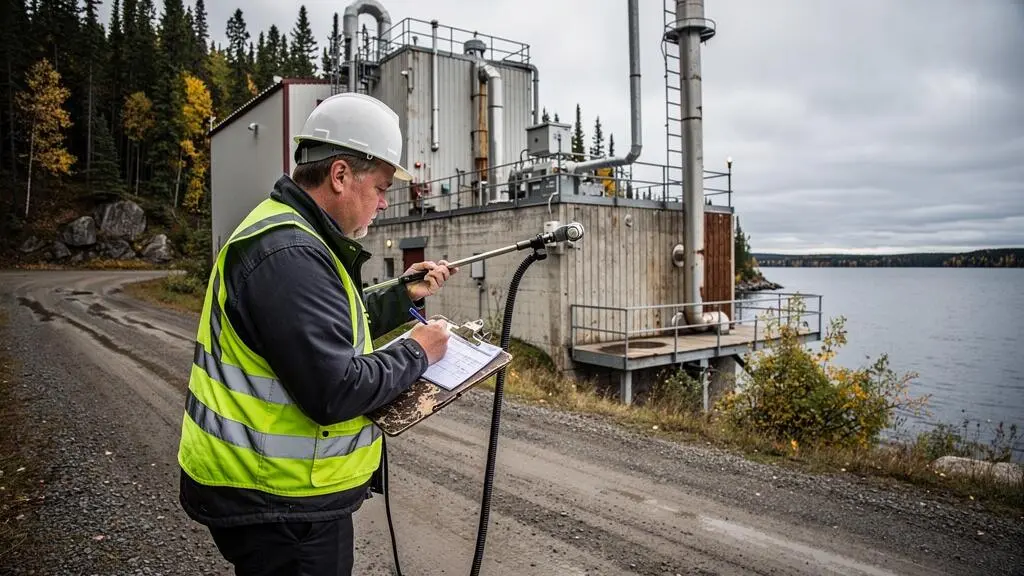
Canadian environmental policy balances protection and economic activity through a combination of regulations, economic incentives, environmental assessments, conservation measures and public monitoring. Rather than applying one national set of rules, Canada distributes environmental responsibilities among federal, provincial, territorial and Indigenous authorities. This allows policies to reflect regional conditions, but it also creates differences in compliance requirements and economic costs.
The balance is not simply between protecting nature and allowing businesses to operate. Governments must also consider whether environmental measures achieve measurable improvements, whether their costs fall fairly across households and industries, and whether restricting activity in one location merely transfers environmental damage elsewhere.
Canada’s reported greenhouse gas emissions reached 685 megatonnes of carbon dioxide equivalent in 2024, while its recognized conserved areas remained below national conservation targets at the end of 2025. These indicators illustrate both progress and unfinished work. Understanding the tools behind them helps Canadians evaluate policies based on environmental results, economic consequences and long-term effectiveness rather than political labels alone.
Canadian environmental policy at a glance
- Federal, provincial, territorial and Indigenous authorities influence environmental decisions, creating different requirements for similar activities across Canada.
- Regulations, industrial carbon pricing, incentives and conservation measures address different problems. Their effectiveness depends on measurable outcomes, not simply the number of policies introduced.
- Economic fairness, pollution displacement and infrastructure investment determine whether environmental improvements can be sustained without imposing avoidable costs.
- Why Do Environmental Rules Differ Across Canada?
- How Can You Tell Whether an Environmental Policy Is Actually Working?
- Incentives or Regulation: Which Works Better for Environmental Policy?
- When Can an Environmental Policy Simply Move the Problem Elsewhere?
- When Should Governments Tighten Environmental Policy Measures?
- How Can Households Identify Where Carbon Costs Affect Their Budget Most?
- Personal Choices or Policy Change: Which Cuts More Emissions?
- What Climate Action Can Deliver the Greatest Impact in Canada?
Why Do Environmental Rules Differ Across Canada?
Environmental rules differ across Canada because environmental protection is a shared constitutional responsibility, not an exclusive federal or provincial power. Federal legislation addresses matters within Parliament’s jurisdiction, while provinces regulate many aspects of natural resources, land use and local infrastructure. Territorial arrangements and Indigenous rights add further responsibilities, making regulatory requirements dependent on both location and activity.
The Canadian Constitution does not assign environmental protection as one unified subject to a single government. Instead, environmental laws draw authority from several constitutional powers. The federal government can regulate matters involving fisheries, navigation and shipping, and certain harmful substances through its criminal law authority. Provinces exercise substantial powers over property, municipalities, public lands and natural resources.
This division is explained in Environment and Climate Change Canada‘s briefing on environmental jurisdiction. The document describes the constitutional framework as of November 2019; it should not be treated as a complete statement of every regulatory requirement currently in force.
Federal instruments include the Canadian Environmental Protection Act, 1999, federal fisheries protections, environmental assessment requirements for projects falling within federal jurisdiction, and species-at-risk measures. Provinces operate their own industrial permitting systems, pollution standards, electricity policies, parks and resource-licensing regimes. Territorial governments exercise responsibilities under their applicable legislation and devolution arrangements.
Alberta’s regulatory framework reflects its substantial oil and gas production activities, while British Columbia has a distinct history of broad-based provincial carbon taxation and environmental regulation. British Columbia’s historical carbon tax should not be confused with a permanent, uniform Canadian consumer carbon price: provincial and federal pricing arrangements have changed over time.
For a business or property owner, the consequences are practical. A factory may need provincial air-emissions approvals while also complying with applicable federal legislation. A farm’s water-use obligations may differ by province. A residential development can be subject to municipal planning requirements, provincial environmental restrictions and federal protections where relevant.
Indigenous jurisdiction and governance are equally important to understanding the regulatory landscape. Indigenous rights, treaty obligations, consultation requirements, co-management arrangements and Indigenous-led conservation initiatives can affect project design and decisions. Impact benefit agreements may also establish negotiated economic and environmental commitments, although they do not automatically replace statutory approvals.
Five steps to identify the environmental rules affecting a project
- Define the activity and location. Prepare a one-page description identifying the province or territory, site and proposed operations.
- Identify potential environmental effects. Create a list covering air emissions, water use, waste, habitat and land disturbance.
- Check government responsibilities. Build a jurisdiction table identifying potentially relevant federal, provincial, territorial and municipal authorities.
- Identify Indigenous rights and governance considerations. Record relevant communities, applicable processes and questions requiring confirmation with competent authorities.
- Confirm approvals and obligations. Produce a permit-and-compliance register showing the responsible regulator, applicable requirements, deadlines and outstanding questions.
Different requirements do not automatically indicate weaker or stronger environmental protection. The important question is whether each jurisdiction’s combination of rules addresses the environmental risks associated with its activities and ecosystems. Answering that question requires looking beyond regulatory structure to actual results.
How Can You Tell Whether an Environmental Policy Is Actually Working?
An environmental policy is working when credible evidence shows that it improves the environmental outcome it was designed to influence, while its costs and unintended effects remain proportionate. Passing regulations or issuing permits demonstrates government activity, not necessarily environmental success. Effective evaluation compares measured outcomes against a credible baseline and considers other factors that could explain the observed changes.
The first distinction is between policy outputs and environmental outcomes. Outputs include inspections conducted, permits issued, funding distributed and hectares formally designated for conservation. Outcomes include lower greenhouse gas emissions, cleaner waterways, reduced ecological degradation and improvements in species populations.
Outputs can be measured relatively quickly. Environmental outcomes may require years of observations, particularly where ecosystems respond slowly or several pressures interact.
Canada’s official environmental reporting provides several ways to investigate effectiveness:
- Greenhouse gas inventories: track national and sectoral emissions over time, but do not independently prove which policies caused changes.
- Water quality monitoring: helps identify pollution conditions and trends, although monitoring coverage and comparability vary by location.
- COSEWIC assessments: evaluate wildlife species’ conservation status and risks, but do not by themselves establish the effectiveness of one particular policy.
- Commissioner of the Environment and Sustainable Development audits: examine aspects of federal program management and performance, without necessarily measuring every final ecological outcome.
685 Mt CO₂ eq
Canada’s reported greenhouse gas emissions in 2024, excluding land use, land-use change and forestry. This was 10.3% below the 2005 level. The trend does not establish the contribution of any single policy.
Canada’s official greenhouse gas emissions indicators, Environment and Climate Change Canada, using the 2026 National Inventory Report.
To judge causation, ask what would probably have happened without the policy. Emissions can fall because of cleaner technology, changing production levels, economic downturns or variations in fuel prices. Canada’s sharp emissions decline in 2020, for example, was partly associated with pandemic-related reductions in travel and economic activity.
A stronger assessment compares actual results with a pre-policy forecast, examines comparable jurisdictions where feasible, and checks whether changes align with the policy’s implementation dates. These comparisons remain imperfect when economic structures or other policies differ.
Conservation illustrates a second measurement problem. At the end of 2025, Canada recognized 14.0% of its terrestrial area recognized as conserved and 15.5% of its marine territory as conserved. These figures describe conservation coverage, not whether every ecosystem within those areas is recovering.
14.0% terrestrial | 15.5% marine
The proportions of Canada’s terrestrial and marine areas recognized as conserved at the end of 2025. Both remained below the national 25% conservation targets for that year.
Environment and Climate Change Canada’s conserved areas indicators.
Time horizons also matter. Habitat restoration may take years to improve population trends, whereas reduced industrial discharge can produce more immediate monitoring changes. Conversely, short-term improvements may coexist with infrastructure investments that commit an economy to higher future emissions.
The strongest assessments therefore combine environmental indicators, credible comparisons, implementation evidence and cost information. Once the intended outcome is clear, the next question becomes which policy instrument can achieve it most effectively.
Incentives or Regulation: Which Works Better for Environmental Policy?
Neither incentives nor regulations are consistently superior. Economic incentives can encourage businesses and households to find lower-cost ways to reduce pollution, while regulations establish enforceable limits or technology requirements. Incentives often provide flexibility; standards can provide greater certainty about specific behaviours or performance thresholds. The best choice depends on the environmental problem, available alternatives and enforcement capacity.
Pricing instruments such as carbon taxes and emissions trading systems create a financial reason to avoid pollution. A business facing an emissions cost may improve efficiency, replace equipment or modify production when the resulting savings justify the investment.
Performance standards work differently. They establish obligations that regulated parties must satisfy, regardless of whether voluntary changes would otherwise be financially attractive. Vehicle emissions standards and requirements to phase out conventional coal-fired electricity illustrate this approach.
The main trade-offs can be summarized as follows.
| Criterion | Economic incentives and pricing | Regulations and standards |
|---|---|---|
| Primary mechanism | Changes the financial rewards or costs associated with environmental decisions. | Establishes enforceable requirements, limits or prohibitions. |
| Flexibility | Allows regulated parties to select responses according to their circumstances. | Depends on whether requirements prescribe technologies or permit performance-based compliance. |
| Environmental certainty | Depends on the instrument; a tax does not guarantee a fixed emissions quantity. | Can offer clearer minimum performance requirements, provided compliance is effective. |
| Economic risks | May expose households or businesses to costs and create competitiveness concerns. | Can impose high compliance costs where alternatives are expensive or unavailable. |
| Policy weaknesses | Weak price signals, poorly targeted subsidies or payments for actions that would occur anyway. | Inflexibility, limited enforcement and requirements that become outdated. |
Canada demonstrates why the distinction is rarely absolute. The federal consumer fuel charge ceased applying on April 1, 2025. The government also removed the federal requirement for provinces and territories to maintain a consumer-facing carbon price. This change did not mean that every industrial pricing arrangement or provincial environmental requirement disappeared.
Industrial carbon pricing systems use mechanisms that can combine emissions costs with output-based performance standards intended to maintain incentives to reduce emissions while addressing competitiveness risks. The precise arrangements depend on the applicable jurisdiction and regulatory framework.
The historical policy change is documented in Department of Finance Canada‘s backgrounder on removing the consumer carbon price. This March 2025 document establishes the change at that time, rather than every subsequent development in industrial pricing.
Subsidies introduce another challenge: a rebate may pay someone to purchase equipment they would have bought without assistance. This is known as a free-rider effect. Regulations, meanwhile, are not inherently permanent or politically immune to change; governments can amend or repeal them, and compliance costs can generate substantial opposition.
In practice, a well-designed policy mix may pair industrial pricing with mandatory standards, or consumer incentives with building codes and equipment regulations. Its effectiveness depends on whether these tools reinforce rather than contradict one another.
The policy mix should also account for a less obvious failure: an environmental measure can succeed within its jurisdiction while transferring production, consumption or ecological damage to another location.
When Can an Environmental Policy Simply Move the Problem Elsewhere?
An environmental policy can move a problem elsewhere when it restricts pollution or resource use in one location without reducing the underlying demand. Production may relocate, resource extraction may shift to another landscape, or consumers may buy imported products with similar environmental impacts. This displacement can make local results appear better than the actual national or global improvement.
This problem is often called environmental leakage. Carbon leakage occurs when climate-related costs or requirements contribute to emissions-intensive activity moving into jurisdictions with less stringent controls. Whether leakage actually occurs depends on production costs, trade exposure, available technologies, market demand and differences between jurisdictions.
Consider a hypothetical Canadian manufacturer facing stricter emissions limits. If it modernizes its facility and maintains production with lower emissions, the policy produces a genuine improvement. If production instead moves to a facility abroad with higher emissions, Canada’s reported emissions may decline without a comparable global benefit.
Conservation measures can create similar spatial effects. Protecting a forest may prevent logging inside its boundaries, but harvesting pressure could move into nearby unprotected forests. The conservation area remains valuable, yet the wider ecological gain depends on what happens across the entire landscape.
Canada’s conserved-area indicators measure recognized geographic coverage. They do not independently determine whether logging, fishing or development activity has been displaced elsewhere.
Another concern is the rebound effect. Greater energy efficiency lowers the cost of obtaining a service, potentially encouraging more consumption. For example, a more efficient vehicle can reduce fuel use per kilometre, but some of the savings may be offset if its owner drives farther.
The rebound effect is not automatic and does not mean efficiency improvements are ineffective. Its size depends on behaviour, prices and the particular technology.
Three diagnostic questions help identify policies vulnerable to displacement:
- Does the measure restrict local supply while leaving underlying demand largely unchanged?
- Can the affected production, investment or resource use relocate relatively easily?
- Does evaluation cover effects outside the regulated area, including imports, neighbouring habitats and alternative production sites?
These questions encourage broader monitoring. A provincial pollution measure may require comparison with other provinces; a conservation initiative may need landscape-level biodiversity indicators; and an industrial climate policy may require examination of production and trade patterns alongside domestic emissions.
Displacement risks do not justify abandoning environmental protections. They suggest that effective policies often need coordinated standards, wider monitoring boundaries and complementary measures that address demand as well as production.
When Should Governments Tighten Environmental Policy Measures?
Governments should consider tightening environmental measures when credible evidence indicates that existing policies are unlikely to meet their objectives, scientific findings reveal greater risks, or cleaner alternatives become technically and economically feasible. The decision should weigh the environmental cost of delay against the financial and social consequences of faster adjustment, rather than relying on fixed timelines alone.
Canada’s emissions record demonstrates why progress and adequacy are different questions. Reported national emissions fell by 10.3% between 2005 and 2024. Canada’s stated 2030 reduction target is 40–45% below its 2005 level. This gap between historical progress and the target indicates substantial further reductions are needed, although historical figures alone cannot determine the precise policy changes required.
Environmental standards may also need revision when scientific knowledge improves. Updated evidence about toxic substances, air pollution, critical habitat or cumulative ecological impacts can show that an existing threshold no longer provides the intended protection.
Technology changes create a different opportunity. When low-emissions equipment becomes more affordable or widely available, stronger performance standards may become achievable at lower cost than previously expected.
However, timing matters economically. Tightening requirements too abruptly can impose unexpected equipment replacement costs, reduce asset values or create difficulties for communities dependent on particular industries. Delaying necessary measures can lock in additional emissions and pollution through infrastructure that remains in service for decades.
Useful policy design mechanisms include:
- Scheduled reviews: reassessing standards or programs against new evidence at predetermined intervals.
- Gradual compliance trajectories: giving businesses advance notice of increasingly demanding requirements.
- Sunset provisions: ending temporary measures unless they are renewed or replaced after review.
- Targeted transition support: helping affected workers, households or businesses adapt without permanently removing the incentive to improve environmental performance.
For climate policy, governments can consider the cost of securing additional emissions reductions alongside the remaining emissions compatible with their targets. These comparisons are more informative than the initial cost of a measure alone because delayed action can increase future adjustment requirements.
Fairness is essential to durable implementation. Rural households, energy-intensive industries and regions with limited alternatives can experience disproportionate costs. Rebates, infrastructure assistance or transitional arrangements may improve acceptance, but broad exemptions can weaken the policy if they remove substantial sources of pollution from its scope.
Policy credibility depends on explaining both the environmental objective and the adjustment pathway. Predictable requirements can support investment planning, while abrupt reversals can create uncertainty even when they reduce immediate compliance costs.
These considerations become particularly concrete when environmental costs reach household budgets. Understanding where those costs arise is necessary before evaluating whether a policy is economically fair.
How Can Households Identify Where Carbon Costs Affect Their Budget Most?
Canadian households can identify their greatest exposure to carbon-related costs by examining home heating, transportation, electricity and purchases whose prices include energy or freight expenses. The most useful approach is to separate direct fuel spending from indirect costs, compare seasonal patterns and identify equipment choices that influence long-term energy consumption. Actual exposure varies considerably by province, location and household circumstances.
Carbon-related costs do not all come from an explicit carbon tax. Fuel prices reflect numerous influences, including commodity markets, conventional taxes, transportation costs and supply conditions. Environmental compliance requirements can also affect prices paid by businesses and consumers.
Household spending can be examined through three channels:
- Direct fuel purchases: gasoline, diesel, natural gas, heating oil or propane consumed by the household.
- Utility expenses: electricity and other energy services, where costs depend partly on local supply systems and applicable regulatory arrangements.
- Indirect expenses: goods and services whose production, distribution or delivery require energy, including groceries and freight-intensive products.
The federal consumer fuel charge ended on April 1, 2025, and the final Canada Carbon Rebate payment was issued under the arrangements announced for April 2025. The former recurring federal household rebate should therefore not be counted as an ongoing payment when assessing a current budget.
Historically, federal rebate eligibility and payment amounts depended on household composition and region, with additional support for eligible rural residents. Provincial arrangements can differ, and current household calculations must reflect the specific taxes, charges and programs actually applicable in the relevant jurisdiction.
A straightforward household review starts with twelve months of energy bills and transportation spending. Monthly totals reveal whether costs are concentrated in winter heating, summer cooling or year-round driving. Comparing those patterns with fuel consumption helps distinguish price changes from changes in energy use.
Geography changes the results. A rural household relying on long-distance driving may be more exposed to transportation fuel costs than a household with convenient public transit. A home heated with oil may have different seasonal spending and replacement options than one using electricity. Electricity costs and associated emissions also depend on the provincial generation mix.
For many households, the most consequential controllable decisions involve equipment rather than minor daily adjustments. Replacing an aging furnace, improving insulation or selecting a different vehicle can influence energy spending for years.
That does not mean replacing functioning equipment immediately is always economical. Equipment purchase costs, expected service life, local energy prices, available incentives and household financing should all be considered. A home energy assessment can help prioritize improvements before major replacement decisions.
A useful budget analysis separates current expenses from future equipment choices and distinguishes environmental-policy effects from ordinary market price movements. That distinction also helps clarify how much households can accomplish through personal decisions compared with public policy.
Personal Choices or Policy Change: Which Cuts More Emissions?
Policy change generally has greater potential to reduce emissions across an entire economy because it can influence electricity generation, industrial standards, transportation networks and building requirements. Personal choices can still deliver meaningful reductions, particularly when households replace high-emissions equipment. The two approaches reinforce each other: policy changes available options, while individual decisions influence adoption and public support.
A household can choose how it heats its home or which vehicle it purchases, within financial and practical constraints. It cannot independently determine the emissions intensity of the electricity grid, the availability of public transit or the rules applied to major industrial facilities.
Those wider systems determine the emissions impact and feasibility of personal decisions. An electric vehicle’s operating emissions depend partly on the electricity used for charging. A heat pump’s environmental benefit depends on the heating system it replaces, local climate conditions, equipment performance and electricity supply.
For many households, high-impact opportunities include:
- Heating transitions: improving building efficiency and replacing fossil-fuel heating with suitable lower-emissions alternatives.
- Transportation changes: reducing vehicle kilometres where practical, selecting an appropriately sized efficient vehicle or transitioning to electric transportation.
- Major retrofits: addressing insulation, air leakage and inefficient systems that create avoidable energy demand.
- Consumption choices: reducing waste and emissions-intensive consumption where feasible, while recognizing that effects vary substantially by product and behaviour.
Major equipment transitions can have much greater long-term influence than isolated packaging choices, especially in households dependent on fossil-fuel heating or extensive driving. However, there is no universal ranking applicable to every Canadian household. A renter without control over heating equipment faces different opportunities from a homeowner replacing a furnace.
Small actions are not necessarily meaningless. Their importance depends on their actual effects and whether they support broader changes. The problem arises when minor visible behaviours are treated as substitutes for addressing large sources of emissions.
Businesses also have responsibilities that cannot be replaced by household action. They can improve industrial processes, reduce operational emissions, assess suppliers and make procurement decisions that affect emissions across their operations.
The choice between personal and political action is therefore a false binary. Individual uptake can demonstrate demand for cleaner products and services, while public policy can help make those choices accessible and affordable.
A practical decision rule is to act directly where meaningful control exists and support institutional change where it does not. For example, a homeowner may plan a heating retrofit while also participating in discussions about electricity infrastructure and building standards.
Personal engagement can take different forms, including participation in public consultations, informed discussions about infrastructure and examination of environmental commitments by elected representatives. These actions influence collective choices rather than generating an immediately measurable household emissions reduction.
Effective climate action connects household investments, business decisions and government policies. Determining where the greatest impact is possible then requires considering Canada’s largest emissions sources and the infrastructure linking them.
Key takeaways for choosing climate action
- Prioritize measured emissions reductions and environmental outcomes rather than the visibility or popularity of an initiative.
- Consider whether a proposed measure reduces total impacts or merely moves production, pollution or resource use elsewhere.
- Match the action to the authority and resources of the person, business or government responsible, while accounting for long-term infrastructure decisions.
What Climate Action Can Deliver the Greatest Impact in Canada?
The greatest climate impact in Canada will come from sustained reductions in major emitting activities, supported by cleaner electricity, effective industrial controls, efficient buildings and lower-emissions transportation. No single action dominates every sector. Governments, businesses and individuals control different decisions, so the strongest approach combines sector-specific measures with infrastructure investments that make additional reductions possible over time.
Canada’s emissions profile highlights the importance of understanding sector differences. Oil and gas production, transportation, buildings, electricity generation and other industrial activities present distinct technical and economic challenges.
Some emissions can be reduced through established equipment changes. Others require more extensive process modifications, infrastructure development or changes in energy supply. The potential impact of a particular intervention depends on baseline emissions, the reductions it can deliver and how quickly those reductions can be implemented.
Electricity infrastructure provides an important connection across sectors. As electricity generation becomes less emissions-intensive, electrification can deliver larger benefits in transportation, buildings and suitable industrial applications.
For example, replacing fossil-fuel heating with an efficient electric heat pump can reduce direct building emissions. The broader climate result depends on the electricity system and the emissions associated with the heating equipment being replaced. Similarly, electric transportation can shift energy demand from petroleum fuels to electricity, making grid emissions and charging infrastructure important considerations.
Cleaner electricity is an enabling investment, not simply a separate sectoral objective. Grid upgrades, generation planning and transmission capacity can affect the feasibility of emissions reductions elsewhere in the economy.
The responsibilities and opportunities of different actors can be compared directly.
| Actor | Decisions within their control | Potential climate contribution |
|---|---|---|
| Households | Heating equipment, vehicle purchases, home efficiency and some consumption decisions. | Reduce direct energy demand and fossil-fuel use where practical alternatives exist. |
| Businesses | Production processes, equipment, energy procurement, operational efficiency and supply-chain choices. | Reduce operational emissions and influence the environmental performance of purchased inputs. |
| Governments | Regulatory standards, infrastructure investment, public procurement and policy incentives within their jurisdictions. | Change the systems, requirements and economic conditions affecting emissions across many activities. |
For industrial emissions, a policy’s impact depends on whether it encourages real improvements in production processes and energy use, rather than simply transferring activity to another jurisdiction. Industrial performance standards and pricing mechanisms can contribute, but their results require evidence of actual emissions changes and the costs of compliance.
For biodiversity and conservation, the same logic applies. Expanding recognized protected and conserved areas is an important policy output, yet ecological effectiveness also depends on habitat quality, connectivity, management and pressures beyond protected boundaries.
A useful approach to evaluating proposed climate actions is to ask four questions: What emissions source does the action address? How much reduction is reasonably expected? Could the action shift emissions elsewhere? And what infrastructure, funding or regulatory conditions are needed to sustain its benefits?
The available Canadian emissions indicators provide a foundation for assessing progress, but they do not establish a universal ranking of the lowest-cost measures or the emissions reduction attributable to every intervention. Those conclusions require more targeted evidence, including project-level or sector-specific analysis.
For a practical next step, choose one environmental issue affecting your household, business or community, identify the responsible decision-maker, consult the relevant Canadian environmental indicators, and compare proposed solutions by expected outcomes, economic costs and displacement risks. That process provides a stronger basis for action than choosing measures solely because they are familiar or politically prominent.
Does federal environmental law automatically override provincial rules?
No. Federal and provincial environmental legislation can both apply to the same activity when each law falls within the relevant government’s constitutional authority. Specific conflicts may raise questions about federal paramountcy, but the existence of overlapping regulations does not automatically invalidate provincial requirements. The applicable legal framework depends on the activity and legislation involved.
Is Canada still applying a federal consumer carbon tax?
The federal consumer fuel charge ceased applying on April 1, 2025. This change was distinct from industrial carbon pricing and did not eliminate conventional fuel taxes or every provincial environmental charge. The historical federal household rebate program also ended after its final payment arrangements in April 2025. Current industrial and provincial requirements must be checked separately.
Does creating a protected area mean all economic activity must stop?
No. Permitted activities depend on the protected area’s legal designation, management objectives and applicable rules. Canada’s conserved-area statistics include both protected areas and other effective area-based conservation measures. Some conservation arrangements allow particular forms of sustainable use while maintaining conservation objectives.
Why might national emissions fall without proving that climate policy succeeded?
Emissions can change because of economic conditions, industrial production, technological improvements, fuel prices or temporary disruptions. Canada’s emissions decrease during the COVID-19 pandemic illustrates why changes in economic activity must be considered. Determining policy effectiveness requires comparison with a credible estimate of what would have happened without the measure.
How can Canadians compare environmental priorities in their province?
Start with the relevant provincial or territorial environmental reporting and compare it with federal indicators covering emissions, water quality and conserved areas. Examine the reporting periods, definitions and environmental outcomes rather than comparing targets or spending commitments alone. Consider local industries, ecosystems, Indigenous governance arrangements and whether policy effects extend beyond provincial boundaries.