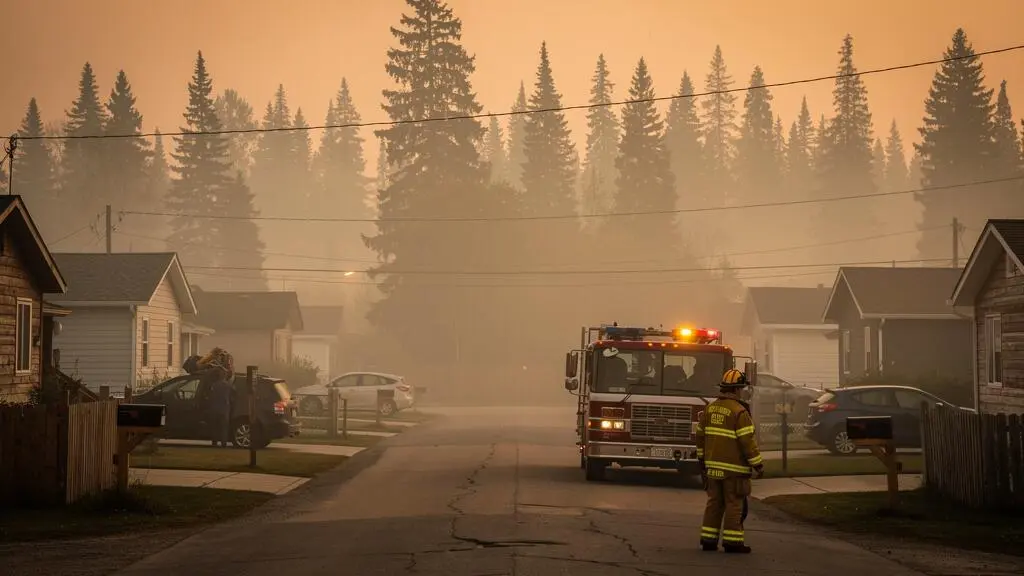
Canada’s most serious environmental challenges include climate change, biodiversity loss, water contamination, air pollution, habitat fragmentation and the ecological pressures associated with resource development. Yet the greatest risk is not necessarily the same in every province, territory or community. Wildfire smoke may dominate one community’s immediate concerns, while another faces coastal flooding, declining freshwater availability or deteriorating infrastructure built on thawing permafrost.
These differences matter because environmental hazards become harmful through a combination of physical exposure, existing vulnerabilities and the capacity to respond. A small northern settlement with limited transportation alternatives may experience an infrastructure failure differently from a large southern city with multiple service networks.
Environmental decisions also involve competing priorities. Governments must weigh immediate protection against long-term emissions reductions, infrastructure maintenance against replacement, and economic opportunities against ecological consequences. Effective responses depend on identifying the relevant pressures, understanding who bears their costs and matching available resources to realistic interventions.
Canada’s environmental risks at a glance
- Geography shapes exposure: wildfire, drought, flooding, pollution and permafrost instability affect Canadian regions differently.
- Local evidence should guide spending: the most visible threat is not necessarily the most consequential or actionable.
- Early, coordinated action matters: adaptation, emissions reduction, infrastructure planning and environmental monitoring work best as connected priorities.
- Why Are Canada’s Environmental Challenges So Different From Region to Region?
- How Can Communities Prioritize the Environmental Risks That Matter Locally?
- Mitigation or Adaptation: Where Should Limited Environmental Funding Go First?
- Why Can Delaying Environmental Action Become More Expensive Later?
- When Should Environmental Warning Signs Lead to Policy Action?
- How Can Communities Assess Whether a Clean Energy Project Fits Local Needs?
- Repair or Build New: Which Infrastructure Choice Delivers Better Value?
- What Makes a Policy Initiative Work in Practice in Canada?
Why Are Canada’s Environmental Challenges So Different From Region to Region?
Canada’s environmental challenges differ because geography, climate, economic activity, infrastructure and governance vary enormously across the country. Coastal communities face different physical hazards from Prairie agricultural regions or northern settlements built on permafrost. Even shared pressures such as warming temperatures and biodiversity loss produce different consequences depending on local exposure, livelihoods and adaptive capacity.
Canada’s vast geographic range creates distinct environmental conditions. Northern warming affects frozen ground, transportation routes and community infrastructure, while warmer southern regions contend with combinations of extreme heat, flooding, wildfire exposure and ecosystem change. Industrial activities add another layer: oil and gas development, intensive agriculture, forestry, mining and fisheries each create different environmental management challenges.
Natural Resources Canada‘s Regional Perspectives Report documents regional climate impacts and adaptation challenges, including coastal flooding in Atlantic Canada, forest-related pressures in British Columbia, water issues across the Prairies and infrastructure vulnerability in northern communities.
The following regional map summarizes prominent pressures. It is an orientation tool, not a ranking of every hazard within each province.
| Region | Prominent environmental pressures | Communities and assets potentially exposed |
|---|---|---|
| Pacific | Wildfire, smoke, flooding, forest ecosystem changes and development pressures | Forest-adjacent settlements, Indigenous communities, rural residents and transportation networks |
| Prairies | Drought, water allocation pressures, agricultural land degradation and resource-development impacts | Farmers, water-dependent communities and areas near industrial development |
| Central Canada | Urban expansion, habitat fragmentation, extreme rainfall and Great Lakes water-quality pressures | Urban residents, shoreline communities and freshwater-dependent industries |
| Atlantic Canada | Coastal erosion, storm surge, flooding and changing marine ecosystems | Coastal households, fishing communities and ports |
| Northern Canada | Permafrost thaw, changing ice conditions, infrastructure vulnerability and ecosystem disruption | Northern and Indigenous communities, transportation routes and essential services |
Some hazards cross borders. Wildfire smoke can travel far beyond the fire itself, while invasive species can spread through connected waterways and transportation networks. Other concerns have a more concentrated geographic footprint, including oil sands tailings management in Alberta or ground instability in permafrost regions.
Responsibility is similarly uneven. Federal, provincial, territorial, municipal and Indigenous governing authorities have different powers and responsibilities. Environmental approvals, land-use decisions, water management and emergency planning may require cooperation across several jurisdictions.
Indigenous communities can face overlapping pressures associated with remoteness, infrastructure gaps and changes affecting culturally important lands and waters. Indigenous knowledge and governance are also essential to understanding local conditions and designing responses that respect rights and community priorities.
Once regional differences are understood, the practical question becomes which hazards deserve attention first within a particular community.
How Can Communities Prioritize the Environmental Risks That Matter Locally?
Communities can prioritize environmental risks by identifying hazards, mapping who and what is exposed, evaluating vulnerability, and comparing the likelihood and consequences of harm. The strongest assessments also consider cumulative impacts, uncertainty and whether local institutions have the authority and resources to intervene. This creates a more defensible basis for action than public attention alone.
The first task is to establish a local hazard inventory. Depending on the area, relevant pressures could include flooding, extreme heat, wildfire smoke, contaminated water, shoreline erosion, groundwater depletion or declining habitat quality. Historic incidents help, but future climate conditions and changing land use must also inform the assessment.
Exposure and vulnerability are related but distinct. Exposure identifies people, buildings, infrastructure and ecosystems that could be affected. Vulnerability considers how severely they might suffer and how readily they can recover. A neighbourhood with limited transportation, fragile drainage and a high proportion of residents requiring assistance may face greater consequences from the same flood event than a better-equipped area.
Available evidence can come from federal climate assessments, provincial hazard maps, municipal asset registers, watershed monitoring, academic research, citizen-science observations and Indigenous knowledge holders. Local knowledge should be incorporated through appropriate relationships and permissions, rather than treated as freely available data.
A practical risk matrix can combine qualitative likelihood and consequence ratings. These ratings should be documented, with uncertainty made explicit, rather than presented as mathematically precise predictions.
Hypothetical example: a coastal community’s competing priorities
Consider a fictional Atlantic Canadian municipality evaluating storm surge and wastewater-system failure. Coastal flooding could have severe consequences for waterfront properties but affect a limited area. Wastewater failures might occur more frequently and disrupt services across a larger population.
The municipality could compare mapped exposure, infrastructure condition, available alternatives and expected recovery costs. Depending on those findings, upgrading wastewater capacity could outrank shoreline protection, or the opposite could be true. Neither result can be established without local evidence.
Communities should also avoid overlooking slow-developing problems. Groundwater depletion, habitat fragmentation and changing ecosystem conditions may receive less attention than an extreme storm, even when their eventual effects are difficult to reverse. Interacting risks, such as heavy rainfall coinciding with inadequate drainage and contaminated runoff, deserve separate consideration.
Five actions for creating a community environmental risk register
- List the principal local hazards and document their evidence sources in a dated hazard inventory.
- Map exposed homes, services, infrastructure and ecological assets in a basic exposure map.
- Identify vulnerable populations and service dependencies in a community vulnerability profile.
- Assign transparent likelihood, consequence and uncertainty ratings in a comparative risk matrix.
- Record responsible authorities, feasible measures and unresolved funding needs in an action register.
Finally, separate risks local decision-makers can directly influence from those requiring provincial, federal, regional or Indigenous partnerships. A high-priority hazard does not become manageable simply because it appears at the top of a municipal list.
Prioritization makes the problem clearer, but it does not eliminate the difficult choice between preventing future damage and addressing its underlying causes.
Mitigation or Adaptation: Where Should Limited Environmental Funding Go First?
Environmental funding should favour immediate adaptation when a serious, near-term local threat can be reduced effectively, while mitigation deserves priority when reducing emissions or other underlying pressures delivers meaningful long-term benefits. Communities rarely benefit from choosing one exclusively. The better approach is to assess both options against urgency, feasibility, avoided harm and potential unintended consequences.
In climate policy, mitigation reduces greenhouse gas emissions or strengthens carbon sinks, addressing the drivers of climate change. Adaptation reduces exposure and vulnerability to climate impacts already occurring or expected. In broader environmental management, preventing pollution or habitat destruction can also address underlying causes, although these actions should not automatically be classified as climate mitigation.
Mitigation benefits often extend far beyond the community financing the intervention. Adaptation benefits, such as reducing flood damage to a local road, may be easier for residents to observe. This difference can influence public budgets, even when long-term mitigation remains necessary.
The choice can be organized around practical conditions.
| Decision factor | Adaptation priority | Mitigation priority |
|---|---|---|
| Immediate risk | High-consequence flooding, heat or wildfire exposure threatens people or critical services | No comparable immediate emergency, and emissions reduction is feasible |
| Principal benefit | Reduces expected local damage and disruption | Reduces underlying climate pressures and potentially delivers local co-benefits |
| Typical intervention | Floodplain planning, cooling measures or wildfire-risk reduction | Building efficiency, lower-emission energy or transportation systems |
| Key evaluation question | Will the measure remain protective under future conditions? | Are emissions savings credible across the project’s life? |
A project that serves both purposes may have added value. Improving building efficiency, for example, can reduce energy use while supporting indoor thermal comfort. The exact benefits depend on building conditions, energy sources and implementation quality.
Communities must also screen for maladaptation: interventions that reduce one risk while creating or intensifying another. Hard shoreline defences may alter erosion patterns elsewhere. New flood protection can encourage additional development in places that retain residual risks. Project assessments should therefore examine long-term climate conditions, downstream effects, equity and the possibility of changing course.
CAD 5.3 billion per year
Estimated annual municipal climate adaptation needs in Canada, as reported in the 2026 National Adaptation Strategy Progress Report. This is an estimated funding requirement, not annual expenditure.
Government of Canada’s 2026 National Adaptation Strategy Progress Report
Canadian funding may involve federal climate programs, provincial cost-sharing and disaster assistance arrangements. Eligibility, application windows, eligible expenditures and matching-fund requirements vary and must be verified before a project is included in a financial plan.
The investment decision must also account for time: delaying necessary protection or prevention can change the eventual cost dramatically.
Why Can Delaying Environmental Action Become More Expensive Later?
Delaying environmental action can increase costs because damage accumulates, vulnerable development expands and cheaper preventive options disappear. Communities may ultimately pay for emergency response, repeated repairs or property relocation instead of planned risk reduction. Some losses, including species extinction and irreversible ecosystem change, cannot be fully expressed as financial costs or reversed through later spending.
One important mechanism is growing exposure. If new buildings, utilities or roads are added to a flood-prone area, future protection becomes more expensive because more assets depend on the same location. A land-use decision that appears affordable today may create long-lasting financial obligations.
Another mechanism is repeated recovery spending. When vulnerable infrastructure is restored without correcting the underlying risk, similar damage can recur. Wildfire suppression, flood recovery and repairs to northern infrastructure illustrate why emergency expenditure and long-term planning need to be examined together.
Canada’s 2026 National Adaptation Strategy Progress Report identifies major pressures associated with wildfire, flooding, heat, storms and permafrost thaw. It also highlights the importance of climate risk assessments and resilient infrastructure planning. These findings support proactive assessment, but do not imply that every preventive project automatically produces net financial savings.
Delay can also remove future choices. An ecosystem may deteriorate beyond practical restoration, or land required for a protective measure may become unavailable after development. Climate risks affecting long-lived infrastructure can intensify during the asset’s operating life.
A simple local decision test compares the cost of acting today with the expected costs of waiting:
- Estimate the initial investment, operation and maintenance costs of acting now.
- Identify plausible future damage, emergency response, service disruption and retrofit costs without intervention.
- Consider how risk changes with climate conditions, development growth and the asset’s expected lifespan.
- Evaluate uncertainty using multiple scenarios rather than relying on a single predicted outcome.
- Identify environmental and social impacts that monetary calculations may not capture adequately.
This is a decision framework rather than a universal calculation. The answer depends on local evidence, assumptions about future hazards and the credibility of estimated costs.
Political incentives can make postponement attractive. Preventive action often requires immediate, concentrated spending, while the costs of inaction are distributed among future residents, insurers, businesses and governments. Risk disclosure, forward-looking building standards and infrastructure asset-management requirements can help make future liabilities visible before decisions are finalized.
Because delay can be costly but premature action can also misallocate resources, policymakers need credible warning signs that justify intervention.
When Should Environmental Warning Signs Lead to Policy Action?
Environmental warning signs should trigger policy action when credible evidence indicates a serious risk, especially if potential damage is irreversible or delay would substantially increase harm. Reliable triggers include persistent trends, independent monitoring, established safety thresholds and converging expert assessments. Waiting for complete certainty is not always appropriate, but a single unusual event rarely justifies an entire policy response on its own.
Monitoring data become useful when decision-makers define how observations affect their responsibilities. A worsening water-quality indicator, for example, may justify intensified testing, investigation or intervention depending on the contaminant, applicable standards and affected water uses.
Several Canadian environmental experiences illustrate different responses to evidence.
- Atlantic cod collapse: the northern cod moratorium of 1992 demonstrates the consequences of severe resource depletion and the difficult social and economic decisions involved in restricting harvesting.
- Grassy Narrows: mercury contamination illustrates how persistent pollution can impose long-lasting burdens on Indigenous communities and why identifying a hazard is not equivalent to resolving its consequences.
- Wildfire: severe fire seasons raise questions about land management, building standards, emergency capacity and the protection of communities at the wildland-urban interface.
- Acid rain: Canadian and international emission-control efforts provide an example of how scientific evidence can inform coordinated environmental regulation.
These cases should not be treated as directly comparable policy evaluations. They involve different contaminants, ecosystems, scientific uncertainties, jurisdictions and implementation histories.
The gap between monitoring and policy frequently results from fragmented responsibilities. Environmental information may be collected by universities, municipalities, provincial agencies, federal institutions or community monitoring programs without being assembled into a decision-ready picture. Inconsistent baselines and interruptions to long-term observation can further complicate interpretation.
Communities and journalists can strengthen accountability by examining the underlying indicators, checking whether comparable measurements exist over time and asking authorities what level of change would trigger a response.
The precautionary dilemma is genuine. Acting too aggressively on weak evidence can impose avoidable costs, while waiting can allow irreversible harm. Three questions help determine the appropriate response: How severe could the harm be? How reversible would it be? Who would bear the consequences of waiting?
A proportionate response might begin with further monitoring or a reversible preventive measure. Where credible evidence indicates imminent and serious harm, stronger intervention may be justified even before every causal detail is resolved.
Evidence-based decision-making is equally important when assessing projects promoted as environmental solutions, including renewable energy developments.
How Can Communities Assess Whether a Clean Energy Project Fits Local Needs?
Communities should assess clean energy proposals against actual energy needs, local resource conditions, electricity-system constraints, environmental impacts and enforceable community benefits. A project can contribute to emissions reduction while creating land-use, ecological or financial concerns locally. Its suitability therefore depends on more than the technology’s reputation or the amount of renewable electricity it promises to generate.
The first consideration is technical fit. Wind, solar, hydro and biomass projects depend on different site conditions, resource availability and infrastructure. A proposal should explain expected production, seasonal variability, demand patterns, connections to the electricity system and the potential need for storage or backup generation.
Communities should also distinguish between energy produced locally and benefits actually retained locally. Electricity exports, ownership arrangements and power-purchase agreements may influence whether residents obtain reliable supply, lower costs, revenues or employment opportunities.
Environmental assessment should cover the project’s full lifecycle. Depending on the technology and location, relevant questions include habitat disturbance, water use, land occupation, noise, material requirements, construction traffic and the handling of equipment after retirement.
Decommissioning arrangements deserve particular attention. Communities should examine who is legally responsible for removal, site restoration and waste management, whether adequate financial security exists and how obligations transfer if ownership changes.
For Indigenous, rural and remote communities, project governance can be as significant as generating capacity. Canada’s federal Wah-ila-toos clean energy initiative describes support for renewable energy, capacity building and related efficiency measures, with an emphasis on community-centred approaches and self-determined priorities. Its program description establishes objectives and support mechanisms, not the guaranteed success of individual projects.
Community participation and community ownership are not equivalent. A consultation process, a benefit-sharing payment and an equity investment can create very different rights, revenues and responsibilities.
Before entering an agreement, communities should examine ownership percentages, voting rights, revenue assumptions, contractual benefit commitments, employment and procurement provisions, financial liability and exit arrangements. Where Indigenous rights or interests are affected, applicable legal obligations and Indigenous governance processes must be respected.
A credible proposal should also explain whether promised jobs, local purchases and training opportunities are contractually enforceable or merely anticipated. Financial projections and expected environmental benefits should be tested against realistic operating conditions.
The same lifecycle perspective applies beyond energy generation, particularly when deciding whether existing public infrastructure should be repaired, upgraded or replaced.
Repair or Build New: Which Infrastructure Choice Delivers Better Value?
Repairing infrastructure generally offers better value when an asset remains structurally viable, future hazards can be managed and the repair provides sufficient additional service life. Replacement becomes more attractive when failures recur, maintenance costs accumulate or changing climate conditions make the original design inadequate. Relocating or redesigning infrastructure may be preferable where rebuilding in the same location preserves unacceptable risks.
Comparing the immediate price of a repair with the upfront cost of a replacement is insufficient. The decision should consider total lifecycle cost: capital investment, maintenance, operation, future renewal, disruption and the expected remaining service life of each option.
Repeated repairs can appear affordable because their costs are distributed across annual budgets. Over time, however, recurring interventions may cost more than a durable replacement while delivering poorer reliability.
Climate change complicates the assessment. Restoring a bridge, culvert or water system to its original standard may reproduce weaknesses if flood intensity, temperature conditions or other environmental pressures have changed since construction.
The comparison should therefore include at least three possibilities: repair to the previous standard, repair with climate-resilient upgrades, and replacement or relocation using a design suited to future conditions.
Hypothetical example: a repeatedly damaged municipal bridge
Consider a fictional municipality whose bridge requires repeated repairs after high-water events. A basic repair would involve the lowest immediate expenditure, while upgrading drainage and structural protection would cost more upfront. Replacing the bridge at a different location would require additional capital and potentially changes to the road network.
A fair comparison would examine the remaining service life, expected future flood exposure, maintenance schedules, traffic disruption, emergency access and environmental impacts of each option. If future flooding makes the existing site increasingly unsafe, relocation may warrant consideration despite its higher initial cost.
Decision-makers should also examine whether service demand is growing or declining, whether an asset is nearing the end of its intended lifespan and whether failure would occur gradually or suddenly. Sudden failure of a critical water main or essential transportation link can carry consequences that routine maintenance costs do not capture.
Land-use opportunity costs matter as well. Continuing to protect infrastructure in a highly exposed location may prevent alternative uses of the land, including ecological restoration or floodwater storage.
Budget rules can distort the decision if maintenance funding is more readily available than capital investment. This is a reason to compare options through a common lifecycle framework rather than separate departmental budgets.
Even a well-supported infrastructure decision needs responsible institutions, sustained funding and clear implementation arrangements to produce durable benefits.
Key takeaways for environmental decision-makers
- Translate regional hazards into defined local responsibilities, rather than relying on broad national objectives.
- Require transparent risk assessments and lifecycle evidence before approving major expenditures.
- Connect funding decisions to monitoring, accountability and the ability to revise ineffective measures.
What Makes a Policy Initiative Work in Practice in Canada?
Environmental policy succeeds in practice when responsibilities are clear, financing is reliable, outcomes are measurable and institutions have the capacity to deliver and enforce commitments. In Canada, effective implementation also requires coordination across jurisdictions and meaningful involvement of affected communities, including Indigenous governments. A strong announcement is not evidence of success unless it produces verifiable outcomes over time.
Canada’s environmental governance landscape makes implementation particularly demanding. Federal, provincial and territorial governments hold different responsibilities, while municipal authorities and Indigenous governments have important roles that depend on the issue, location and applicable legal arrangements.
Unclear accountability can delay projects or leave essential tasks unfunded. Successful programs need an explicit description of who makes decisions, who pays, who monitors progress and who responds when targets are missed.
Multi-year financial stability is another requirement. Short application windows and changing program conditions can make it difficult to plan infrastructure renewal, environmental monitoring and community capacity building. A program must also offer realistic timelines and administrative support for organizations with limited staffing.
Canada’s carbon pricing experience demonstrates why durability matters. The federal consumer fuel charge ceased applying on April 1, 2025, while industrial carbon pricing remained part of federal climate policy. The Department of Finance Canada‘s 2025 carbon pricing backgrounder documents this policy change. The distinction shows how an environmental policy framework can continue in modified form even when a major component is discontinued.
This example does not, by itself, establish the effectiveness of either pricing approach. Environmental results require separate evidence about emissions, compliance, economic effects and interactions with other policies.
Implementation also depends on measurable objectives. Programs should identify a starting baseline, relevant indicators, reporting schedules and procedures for responding to underperformance. Counting funded projects or announced commitments is not equivalent to measuring lower pollution, reduced vulnerability or improved ecosystem conditions.
Local and Indigenous participation should begin while objectives and project options remain open to meaningful change. Consultation after fundamental decisions have already been made can undermine trust and overlook place-specific needs. Collaborative delivery requires appropriate authority, accessible information, adequate capacity and respect for Indigenous rights and governance.
Finally, policies must remain adaptable. Environmental pressures change, scientific understanding improves and unexpected consequences emerge. Regular review should allow ineffective measures to be revised without abandoning long-term objectives whenever immediate results prove difficult.
A practical next step is to select one locally significant environmental risk, identify the authority responsible for addressing it, review the available evidence and establish a measurable action with a defined review date. That creates a concrete basis for evaluating whether policy is producing meaningful protection.
What is the difference between an environmental hazard and an environmental risk?
An environmental hazard is a potentially harmful event, condition or process, such as wildfire, contamination or coastal erosion. Environmental risk concerns the potential consequences of that hazard, considering exposure, vulnerability and likelihood. The same hazard can create substantially different risks for different communities.
Can a community assess environmental risks without hiring specialist consultants?
Communities can begin with government hazard information, municipal infrastructure records, local observations and appropriately shared Indigenous knowledge. These sources support preliminary screening and prioritization. Specialist technical assessments may still be necessary for major engineering decisions, complex contamination, legally required studies or projects with significant safety consequences.
How can residents tell whether an environmental policy is actually working?
Residents can look for publicly reported baselines, measurable objectives, monitoring results and evidence that actions are changing environmental or community outcomes. Project announcements and expenditure totals describe activity, but they do not alone demonstrate effectiveness. Results should also be interpreted in light of external factors and the time required for benefits to appear.
Why should environmental assessments include more than climate change?
Climate change interacts with other pressures, including land-use change, pollution, resource extraction, invasive species and biodiversity loss. A community might face serious local water contamination even where climate-related hazards receive greater public attention. Considering multiple pressures helps reveal cumulative effects and avoids solving one problem by worsening another.
How often should a local environmental risk assessment be updated?
There is no universally appropriate update interval for every Canadian community or hazard. Reviews should reflect local planning requirements, the pace of environmental change and the consequences of outdated information. Major disasters, new monitoring evidence, significant development or changes to critical infrastructure can justify an earlier reassessment.