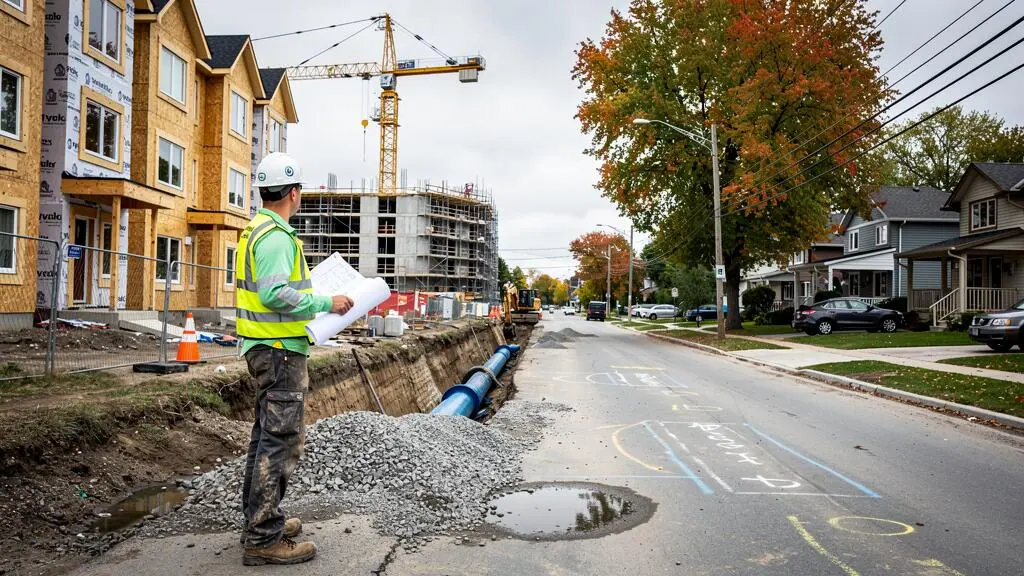
Canada’s demographic transformation is changing how communities accommodate residents, deliver public services and support local economies. Population growth, international migration, shifting settlement patterns and aging are creating different challenges across the country. Some municipalities must prepare for more homes, classrooms and transit passengers, while others must adapt services to older populations or slower growth.
The pace of change matters as much as its direction. Statistics Canada reported that population growth across the country’s 41 census metropolitan areas slowed substantially between 2023–2024 and 2024–2025. Yet conditions still differed sharply between regions. Infrastructure decisions made during periods of rapid expansion may therefore need adjustment as migration and population trends evolve.
For municipal planners, employers and residents, the central question is how to align housing, infrastructure and service capacity with changing local needs. Effective responses depend on reliable demographic indicators, adaptable investment plans and cooperation among governments responsible for different services.
Canada’s demographic change: Key points
- Population growth can outpace infrastructure because residents’ needs change faster than municipal planning and capital investment cycles.
- Aging and migration affect communities differently, making neighbourhood-level demographic analysis more useful than national averages alone.
- Flexible forecasts, infrastructure renewal and coordinated service planning can help municipalities respond without unnecessary expansion.
- Why Can Population Growth Outpace Local Services and Infrastructure?
- How Can Cities Plan Services Around Population Forecasts Without Overbuilding?
- Aging or Growth: Which Demographic Shift Changes Local Services More?
- What Happens When Cities Plan Using Outdated Population Assumptions?
- When Should Population Change Trigger a New Municipal Growth Plan?
- How Can Public Services Reduce Bottlenecks Without Simply Adding Staff?
- Upgrade or Expand: Which Infrastructure Strategy Fits Fast-Growing Areas?
- Which Infrastructure Investments Matter Most for Canada’s Long-Term Growth?
Why Can Population Growth Outpace Local Services and Infrastructure?
Population growth can outpace local services because housing demand and population movements can change within months, while infrastructure planning, financing and construction often take years. Municipalities must accommodate new residents before water networks, schools, transit systems and other facilities can necessarily expand. The resulting mismatch is especially pronounced where growth is concentrated geographically.
Canadian municipalities generally prepare capital budgets and infrastructure plans over multiple years. Building a new wastewater treatment facility, for example, requires assessing future demand, securing funding, obtaining approvals and completing construction. New households can arrive considerably faster than that process can be completed.
Growth is also difficult to observe consistently. Census results, intercensal population estimates, municipal building permits and housing starts measure different aspects of change. A building permit indicates authorized construction, not necessarily an occupied home. Meanwhile, population estimates can reveal demographic shifts that were not fully anticipated when infrastructure budgets were adopted.
According to Statistics Canada’s 2025 subprovincial population estimates, the country’s 41 census metropolitan areas contained approximately Population living in census metropolitan areas 31.17 million people on July 1, 2025, representing 74.8% of the national population.
Annual metropolitan population growth slowed from 3.5% in 2023–2024 to 1.0% in 2024–2025. However, Edmonton grew by 3.0%, while Calgary and Moncton each grew by 2.9%. Toronto’s metropolitan population was virtually unchanged during the latter period. These differences demonstrate why a national growth rate cannot determine an individual city’s infrastructure requirements.
74.8%
Share of Canada’s population living in census metropolitan areas on July 1, 2025. This measures population concentration, not infrastructure shortages.
Statistics Canada, subprovincial population estimates, released January 14, 2026.
Municipal financing adds another constraint. Property tax revenues generally respond to assessment bases, rates and budget decisions, whereas water connections, road improvements and additional service capacity may require substantial upfront expenditure. Development-related revenues and transfers can help finance growth, but their availability and permitted uses differ by jurisdiction.
Because the timing and location of growth are uncertain, municipalities need planning methods that accommodate changing demand without committing too early to facilities they may not need.
How Can Cities Plan Services Around Population Forecasts Without Overbuilding?
Cities can reduce overbuilding risks by using several population scenarios, monitoring actual demand and expanding infrastructure in stages. Instead of treating one forecast as certain, municipalities can identify investments needed under low-, moderate- and high-growth conditions. The objective is to preserve future expansion options while avoiding expensive capacity that remains unused.
A practical forecasting framework combines demographic projections with household formation, housing construction and local employment trends. Each scenario should show not only how many additional residents might arrive but also where they may live and which services they are likely to use.
Different assets require different investment schedules. Underground pipes, pumping stations and major road corridors may need early capacity decisions because subsequent expansion can be disruptive or expensive. Transit frequency, recreation programming and some administrative services can often be adjusted more incrementally, provided vehicles, facilities and qualified workers are available.
Municipalities can also establish a dashboard of indicators between major census releases:
- Building permits and housing completions: signals of potential household growth, interpreted alongside occupancy.
- Utility connections: evidence of development entering service and changing network demand.
- School enrolment: information about the location and age composition of families.
- Transit ridership: evidence of travel demand along existing routes.
- Rental-market and employment indicators: additional context about housing needs and labour-market pressures.
Non-permanent residents deserve particular attention. Changes in international student enrolment, work permits and other temporary-resident categories can affect rental demand and local services without following the household patterns assumed in older suburban planning models.
For example, a hypothetical municipality could reserve land for a future transit facility while initially adding service frequency along an existing corridor. Additional construction would proceed only when ridership, development and funding conditions justified it.
Such staging does not eliminate forecast error. It reduces the consequences of being wrong by linking commitments to observable demand and distinguishing reversible operating decisions from long-lived capital investments.
Forecasting becomes more useful when planners examine who is changing the population, not simply whether the total number of residents is rising.
Aging or Growth: Which Demographic Shift Changes Local Services More?
Neither aging nor population growth consistently has the greater effect on local services. Aging usually increases the importance of healthcare access, accessible transportation and support for independent living. Rapid growth creates different pressures, particularly on housing, schools and infrastructure capacity. The larger challenge depends on a community’s existing age structure, settlement patterns and available services.
An aging municipality may need safer pedestrian crossings, accessible recreational facilities, adapted transit vehicles and housing options suitable for residents wishing to downsize. Demand for home care and long-term care may also increase, although those services are generally organized and financed primarily through provincial or territorial systems.
A fast-growing community with many young families faces another set of needs. School capacity, childcare access, neighbourhood parks and transportation connections become particularly important. Growth concentrated among working-age adults can instead create immediate pressure on rental accommodation, commuting networks and employment-related services.
These changes can occur simultaneously within the same region. Established neighbourhoods may contain increasing numbers of older residents, while recently developed communities attract younger households. Regional population growth can therefore conceal sharply contrasting neighbourhood requirements.
The distinction also matters for public finances. Municipal governments typically manage local roads, land-use planning and many recreational services. Provinces and territories have major responsibilities for healthcare and education. Demographic change consequently requires coordination among authorities rather than assuming one government can independently deliver every response.
A useful diagnostic compares age cohorts with the services they are most likely to need:
| Demographic pattern | Likely service priorities | Planning response |
|---|---|---|
| More children and young families | Schools, childcare, parks and local mobility | Coordinate housing approvals with education and neighbourhood capacity |
| More working-age residents | Rental housing, transit and employment access | Connect housing supply with job locations and commuting demand |
| More older residents | Accessible transport, housing adaptation and community support | Improve accessibility and coordinate with health and social-service providers |
| Population stagnation or decline | Affordable service coverage and asset maintenance | Review facility utilization and consolidate services where appropriate |
The most important measure is not the percentage of older or younger residents alone. Planners should examine how quickly each cohort is changing, where it is concentrated and whether existing facilities can meet projected needs.
Even a well-designed service strategy can fail when it is based on population assumptions that no longer reflect where residents actually live.
What Happens When Cities Plan Using Outdated Population Assumptions?
Outdated population assumptions can lead municipalities to locate services incorrectly, underestimate housing needs and invest in infrastructure that does not match actual demand. The consequences may include overcrowded facilities, underused buildings, longer commutes and delayed residential construction. The severity depends on how far demographic conditions have diverged from the original forecast.
Consider a hypothetical neighbourhood where planners expect a continuing increase in families with children. If the population instead ages and school enrolment declines, proposed classroom capacity may no longer be needed. Another neighbourhood receiving new households could simultaneously struggle with insufficient space.
Transit planning faces similar risks. Routes established around former employment centres may serve fewer passengers than expected if jobs and residences shift to different corridors. Adjusting frequencies and route structures can help, but infrastructure built in the wrong location may be difficult to repurpose.
Housing planning creates longer-lasting consequences. When expected household formation is underestimated, municipalities may designate insufficient residential capacity or delay upgrades required for new construction. Supply constraints can then contribute to affordability pressures, although interest rates, construction costs, incomes and broader market conditions also affect housing prices.
Canada Mortgage and Housing Corporation‘s Fall 2026 Housing Supply Report examines regional housing supply and affordability challenges. Its findings reinforce the importance of local conditions: housing requirements cannot be inferred reliably from national population trends alone.
Housing shortages also affect labour markets. Employers may find it more difficult to attract workers when suitable homes are unavailable near workplaces. Longer commuting distances can reduce the attractiveness of jobs in healthcare, construction and other location-dependent sectors.
Warning signs that population assumptions deserve review include persistent school over-enrolment or under-enrolment, growing service waitlists, unexpected utility-capacity constraints, repeated changes to development forecasts and large differences between planned and observed housing occupancy.
These indicators should be interpreted together. One unusually busy transit route or a temporary school enrolment increase does not necessarily invalidate an entire municipal growth strategy.
When discrepancies persist, the next question is whether targeted plan amendments are sufficient or a broader municipal growth strategy requires revision.
When Should Population Change Trigger a New Municipal Growth Plan?
Population change should prompt a municipal growth-plan review when sustained demographic trends materially affect housing capacity, infrastructure commitments or public-service delivery. A single year of unexpected growth rarely justifies rewriting an entire plan. Persistent deviations from forecasts, major policy changes or substantial local economic shifts provide stronger reasons to reconsider planning assumptions.
Municipalities can establish locally appropriate monitoring thresholds rather than relying on a universal percentage. For example, several consecutive reporting periods in which housing completions, enrolment or utility connections exceed expected levels could trigger a formal assessment.
Structural changes deserve particular attention. A major employer opening or closure may alter migration, commuting and housing demand. Federal or provincial immigration policy changes can also affect population trajectories, especially in communities with substantial international student or temporary-worker populations.
Legal requirements differ across Canada. In Ontario, the Planning Act establishes a framework for official-plan revisions and amendments. Section 26 provides for revision at least ten years after a new official plan comes into effect and every five years thereafter, unless replaced by another new plan. Section 21 addresses amendments.
These Ontario provisions are not a national timetable. Municipalities elsewhere must follow their own provincial or territorial planning frameworks and applicable local requirements.
Five actions to assess whether a municipal growth plan needs updating
- Compare recent population estimates with adopted forecasts and produce a table showing the differences by year and geographic area.
- Review building permits, completed housing, school enrolment and utility connections, producing a dashboard of demand indicators.
- Identify infrastructure and service capacities at risk under updated population scenarios, producing a prioritized capacity register.
- Check applicable statutory review requirements and existing capital commitments, producing a documented list of planning constraints.
- Recommend targeted amendments, forecast recalibration or a comprehensive review, producing a decision memorandum with reasons and proposed next steps.
The scale of the response should match the scale of the change. Updating projections and construction schedules may be sufficient when land-use objectives remain valid. A comprehensive review becomes more appropriate when settlement patterns, infrastructure requirements or land availability have changed fundamentally.
Frequent plan rewrites also carry costs. Developers, infrastructure providers and residents need predictable rules for long-term decisions. Monitoring should therefore distinguish persistent structural changes from ordinary annual fluctuations.
After updating a plan, municipalities still need to deliver services efficiently, particularly when budgets and skilled labour are constrained.
How Can Public Services Reduce Bottlenecks Without Simply Adding Staff?
Public services can reduce bottlenecks by simplifying administrative processes, improving scheduling, introducing appropriate digital services and sharing specialized resources. Additional employees may help when workload genuinely exceeds capacity, but hiring alone cannot resolve inefficient workflows. Municipalities first need to identify where requests accumulate and why decisions are delayed.
Development approvals illustrate the distinction. Applications may spend time awaiting completeness checks, technical review, coordination among departments or formal decisions. Recruiting more reviewers will have limited impact if files repeatedly return for missing information or remain stalled at another approval stage.
Process improvements can include clearer application requirements, standardized documentation, coordinated technical reviews and digital status tracking. Where legislation permits, appropriate delegation can shorten decision pathways without eliminating necessary public accountability or professional oversight.
Demand management offers another option. Appointment systems can distribute visits more evenly throughout the day. Online renewals and service requests may reduce routine counter transactions. Community organizations and libraries can provide complementary assistance where roles, funding and service standards are clearly established.
Cooperation between municipalities can also improve access to scarce expertise. Smaller communities may benefit from jointly procuring specialized engineering, inspection or technical services instead of independently maintaining identical capabilities.
However, digital channels do not serve every resident equally. Older adults, people with disabilities and residents with limited internet access may still require telephone or in-person options. Efficient service design must account for accessibility as well as throughput.
A practical measurement approach follows a request from submission to completion and records waiting time at each stage. Relevant measures include processing time, incomplete submissions, rework frequency, pending applications and service outcomes.
Improving one stage can expose a constraint elsewhere. For example, faster building-permit reviews do not automatically accelerate construction if servicing capacity or qualified trades remain unavailable.
Where infrastructure itself is the limiting factor, communities must decide whether to modernize existing networks or construct additional ones.
Upgrade or Expand: Which Infrastructure Strategy Fits Fast-Growing Areas?
Upgrading existing infrastructure is often preferable when established neighbourhoods can accommodate more residents through network improvements and redevelopment. Expansion becomes necessary when growth occurs beyond currently serviced areas. The appropriate strategy depends on available capacity, geography, development patterns, lifecycle costs and the municipality’s ability to finance future maintenance.
Intensification can use existing streets, transit corridors and utility networks more efficiently. However, an already serviced neighbourhood does not necessarily have spare capacity. Older water mains, wastewater systems and intersections may require significant upgrades before additional housing can be supported.
Expansion into unserviced land creates different obligations. Roads, water pipes, sewers and other facilities must be built and then maintained over their useful lives. These long-term responsibilities should be considered alongside upfront construction costs and anticipated development revenues.
Neither option is automatically cheaper in every case. Dense redevelopment may involve costly excavation, land acquisition and disruption to existing residents. Greenfield development may be more straightforward initially but can create extensive networks requiring long-term upkeep.
Existing infrastructure renewal is already a major national challenge. Statistics Canada’s survey of public infrastructure renewal requirements estimated that 294.4 CAD billion was needed at the end of 2022 to rehabilitate or replace existing core public infrastructure to achieve or maintain good asset condition.
CAD 294.4 billion
Estimated rehabilitation and replacement requirements for existing Canadian core public infrastructure at the end of 2022. This covers eligible provincial, territorial, regional and municipal assets and does not represent the cost of future infrastructure expansion.
Statistics Canada, Canada’s Core Public Infrastructure Survey: Required renewal budgets, 2022; published June 24, 2025.
The same survey reported CAD 31.3 billion in actual renewal investment during 2022. The figures describe different measures—a stock of estimated renewal requirements and expenditure during one year—and should not be interpreted as an immediate construction funding gap.
Municipal investment decisions also depend on provincial rules, development charges, grants and eligibility for infrastructure funding. A project that is technically attractive may not be financially feasible under the available funding arrangements.
Sound comparisons therefore examine costs over the asset’s full life, including maintenance, renewal, operating requirements and the infrastructure capacity unlocked by each alternative.
The broader investment challenge is to support population and economic change while maintaining the infrastructure communities already depend on.
Key takeaways for long-term investment decisions
- Prioritize projects that remove demonstrated housing, transportation or service-capacity constraints rather than relying on projected population totals alone.
- Evaluate new infrastructure alongside the maintenance and renewal obligations of existing public assets.
- Coordinate investment timing with housing development, employment locations and the demographic needs of different communities.
Which Infrastructure Investments Matter Most for Canada’s Long-Term Growth?
The infrastructure investments with the greatest long-term value are those that relieve binding constraints on housing, workforce mobility, economic activity and essential services. In many growing Canadian regions, water and wastewater capacity, housing-enabling infrastructure and reliable transit deserve close attention. Trade corridors, digital connectivity and infrastructure renewal also matter, with priorities varying by community.
Housing-enabling infrastructure can have particularly broad effects. Serviced land, functioning wastewater networks and transportation connections determine whether approved residential development can become usable housing. Where these systems limit construction, expanding capacity may support both population accommodation and labour-market access.
Transit investments are especially relevant in communities where additional housing and employment concentrate along established corridors. More frequent and reliable service can improve access to workplaces and public facilities. However, major capital construction should reflect demonstrated demand, operating funding and realistic ridership scenarios.
Trade infrastructure supports a different dimension of growth. Ports, rail connections and major freight corridors influence how efficiently Canadian businesses move goods between production centres and markets. Their value depends on actual transport constraints, commercial demand and links with existing networks.
Digital infrastructure also has a cross-sector role. Reliable connectivity supports remote work, business operations and access to digital public services. In rural or geographically dispersed communities, connectivity can complement physical service delivery, although it cannot replace every essential in-person service.
Investment priorities should also account for aging communities. Accessible transit, reliable roads and well-maintained public facilities may offer greater local benefits than major expansion projects where population growth is limited.
The following criteria provide a practical framework for evaluating competing investments:
| Investment category | Main potential benefit | Critical evaluation question |
|---|---|---|
| Water, wastewater and serviced land | Enables housing and community development | How much feasible development capacity would the investment unlock? |
| Public transit and local mobility | Improves access to employment and services | Does demand justify capital and ongoing operating costs? |
| Existing infrastructure renewal | Maintains reliability and reduces deterioration risks | What are the consequences of delaying rehabilitation? |
| Trade and freight connections | Supports goods movement and economic activity | Which verified transport bottleneck would be removed? |
| Digital connectivity | Improves communications and access to online services | Which households, businesses or services remain underserved? |
Project delivery is as important as project selection. Permitting, coordination across government levels, procurement and shortages of qualified construction workers can all affect schedules and costs. Announced investment does not produce economic benefits until infrastructure becomes operational and usable.
Ultimately, the strongest investment portfolios balance immediate constraints with long-term demographic uncertainty. They protect existing assets, preserve opportunities for future expansion and direct resources toward locations where people live, work and need services.
Municipalities, employers and community organizations can begin by comparing updated local population indicators with current service capacity, then identify a manageable set of investment priorities supported by measurable needs and realistic delivery plans.
Why can a city experience housing pressure even when population growth slows?
Housing demand depends on more than annual population growth. Household formation, dwelling size, migration between neighbourhoods, available housing types and construction activity all influence local conditions. A slower-growing city may still face shortages in particular rental or ownership market segments, especially when existing supply does not match household needs.
Are census metropolitan areas the same as municipal boundaries?
No. A census metropolitan area is a statistical geography that includes an urban core and surrounding municipalities connected through commuting relationships. Its population trends are useful for regional analysis but may differ from the conditions within an individual municipality. Local governments should therefore examine municipal and neighbourhood indicators when available.
How can smaller Canadian communities respond to demographic change with limited budgets?
Smaller communities can prioritize maintaining essential assets, sharing specialized services with neighbouring municipalities and coordinating with provincial or territorial providers. Reviewing actual facility utilization, accessibility needs and population age structure can help identify where investments will deliver the greatest local benefit.
What role do employers play in adapting to local population changes?
Employers can contribute information about anticipated hiring, workforce mobility, shift patterns and housing challenges. Sharing these signals with local planners can improve understanding of employment-related demand. Businesses can also consider flexible work arrangements, retention measures and collaboration on workforce development where appropriate.
How often should a municipality update its demographic assumptions?
Demographic assumptions should be monitored regularly using available population estimates and local demand indicators. Formal planning review schedules depend on the applicable provincial or territorial framework. A municipality can reassess forecasts between statutory reviews when sustained changes materially affect housing, infrastructure or service planning, without necessarily replacing its entire official plan.