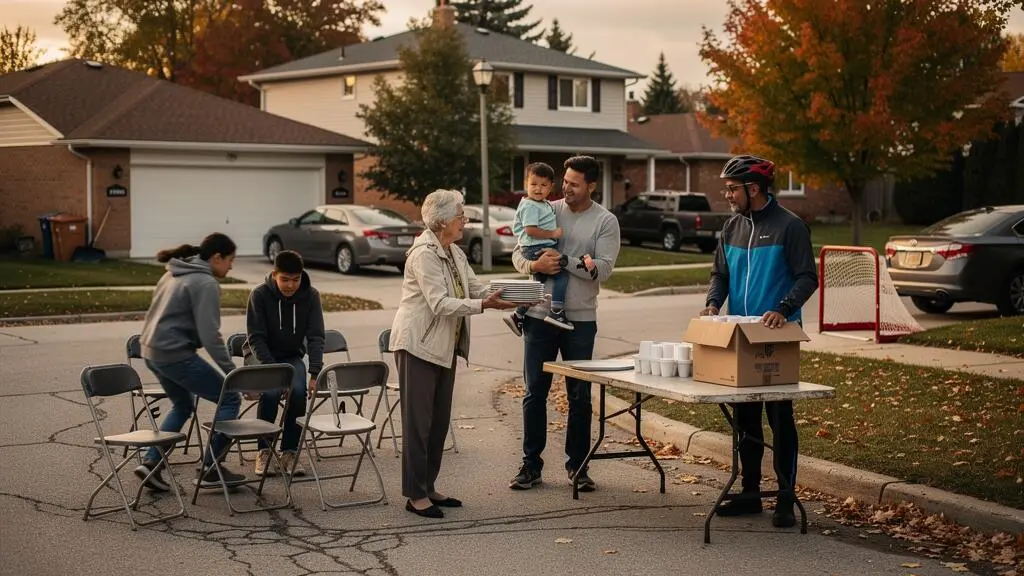
Everyday life in Canada is changing through more than technology or shifting cultural attitudes. Housing pressures influence where families can settle. Population aging changes the demand for care and neighbourhood services. Immigration reshapes communities, while hybrid work alters the places where people form relationships.
These developments affect how Canadians experience belonging, trust, friendship and participation. A neighbourhood can become more culturally diverse while losing familiar gathering spaces. Someone may communicate with dozens of people online yet have few nearby contacts who can offer practical help.
The effects are not uniform. A resident of downtown Toronto, a family in suburban Quebec and an older adult in rural Atlantic Canada may encounter very different versions of the same national trend.
Understanding changing social dynamics therefore requires separating demographic evidence from assumptions about social behaviour. It also means asking which changes require institutional adaptation, which can be addressed locally and which reflect longer-term transformations in Canadian society.
Understanding Canada’s Changing Social Landscape
- Housing, demographic aging, migration and changing work arrangements influence how Canadians organize their relationships and daily routines.
- Strong communities need dependable relationships across different groups, not simply frequent contact or shared cultural backgrounds.
- Comparing national evidence with local experience helps distinguish structural trends from problems that communities can address directly.
- Which Economic and Social Trends Are Reshaping Life in Canada?
- Why Can Social Trust Weaken During Periods of Rapid Change?
- How Can Communities Build Stronger Connections Across Diverse Social Groups?
- Online or In-Person Communities: Which Build Stronger Social Connections?
- How Can Constant Online Contact Still Leave People Socially Isolated?
- When Should Communities Act on Falling Local Participation?
- How Can You Tell Whether a Social Change Is National or Mainly Local?
- Civic or Cultural Identity: Which Better Explains What It Means to Be Canadian?
Which Economic and Social Trends Are Reshaping Life in Canada?
Housing affordability, population aging, changing immigration patterns and hybrid work are among the forces reshaping daily life in Canada. They influence where people live, how families organize care, which institutions they depend on and where relationships develop. Their effects vary considerably between provinces, cities and rural communities.
Demographic aging provides one of the clearest measurable examples. According to Statistics Canada’s 2026 population estimates by age and gender, 20.0% of Canada’s estimated population was aged 65 or older on July 1, 2026. The national median age was 40.9 years.
20.0%
Share of Canada’s estimated population aged 65 or older on July 1, 2026. Preliminary national population estimates, subject to revision.
Statistics Canada, Canada’s population estimates: Age and gender, 2026.
Population aging can change demand for accessible transportation, healthcare appointments, home support and opportunities for intergenerational contact. These are practical implications rather than outcomes established directly by the population estimates.
Housing pressures can influence household formation in different ways. Some adults may remain with relatives longer, while others may choose smaller homes or move farther from employment and established social networks. Longer journeys can leave less time for community involvement, although the experience depends on local housing and transportation conditions.
Immigration adds another dimension. Canada’s exceptionally large migration waves between 2021 and 2024 temporarily moderated demographic aging. Statistics Canada subsequently reported declining international migration levels, making it inaccurate to describe immigration as continuously accelerating.
Meanwhile, hybrid work can reduce commuting while changing opportunities for informal workplace interaction. A shorter commute may free up time for neighbourhood activities, but working remotely can also reduce spontaneous conversations with colleagues.
Institutions often adapt more slowly than everyday routines. Transportation networks, service hours, school arrangements and care systems may still reflect assumptions about commuting patterns, household structures or residential stability that no longer fit everyone.
Regional variation makes national averages incomplete. Newfoundland and Labrador had an estimated 25.7% of residents aged 65 or older in July 2026, compared with 19.5% in Ontario. Differences in local employment, housing and service availability can produce equally distinct experiences within provinces.
A useful starting distinction is between structural and temporary change. Demographic aging is a long-term development, while an individual employer’s closure may produce a sharper local disruption. Housing conditions can reflect both persistent supply constraints and shorter economic cycles.
These broad forces establish the context for another important question: whether people still trust the institutions and neighbours on which everyday cooperation depends.
Why Can Social Trust Weaken During Periods of Rapid Change?
Social trust can weaken when familiar relationships, institutions and expectations change faster than people can adjust. Individuals may become less certain about whom to rely on or which information to believe. However, rapid change does not automatically reduce trust: reliable institutions, repeated cooperation and transparent communication can help preserve it.
Trust acts as a practical shortcut. People rarely investigate every neighbour, volunteer organization or local service before interacting with them. Familiar routines and dependable expectations allow ordinary cooperation without constant verification.
When those expectations become uncertain, interactions may require more effort. A resident unfamiliar with changing neighbourhood practices might hesitate to seek help. Someone dissatisfied with institutional communication might become more cautious about advice received from public authorities.
Two distinct forms of trust matter:
- Horizontal trust concerns confidence in other people, including neighbours, acquaintances and strangers.
- Vertical trust concerns confidence in institutions such as public authorities, healthcare organizations, police and news media.
These dimensions need not move together. Residents may trust neighbours who regularly help one another while remaining sceptical of public institutions. Alternatively, someone may have confidence in public services but feel disconnected from their immediate community.
Statistics Canada’s Canadian Social Survey quality-of-life indicators distinguish trust in others, confidence in institutions, loneliness, local belonging and the availability of someone to count on.
The February 2025 release identifies indicators updated using October–December 2024 survey data. It does not itself provide evidence that each dimension has declined continuously.
Social trust can also influence participation. When people anticipate disappointment or unfair treatment, they may avoid volunteering, attending meetings or approaching unfamiliar organizations. Reduced participation can then limit the positive interactions that might rebuild confidence. This is a plausible reinforcing mechanism, not proof of a universal downward spiral.
Digital information environments introduce further complications. Social media platforms can expose people to conflicting accounts of the same event, sometimes emphasizing exceptional incidents over ordinary cooperation. Two residents of the same city may consequently develop very different impressions of local safety, fairness or community life.
Restoring trust depends on identifying what is missing. Clear institutional procedures may address concerns about accountability, while recurring opportunities for neighbours to cooperate can improve familiarity.
Trust becomes more tangible when people share responsibilities, particularly when those responsibilities bring together residents who would otherwise remain in separate social circles.
How Can Communities Build Stronger Connections Across Diverse Social Groups?
Communities can strengthen connections across social groups by creating regular opportunities for people to work together on shared goals. Repeated contact, accessible meeting spaces and practical cooperation can help relationships extend beyond existing circles. The objective is not simply to celebrate diversity but to build dependable networks of mutual assistance.
Political scientist Robert Putnam‘s distinction between bonding and bridging social capital offers a useful framework. Bonding ties connect people who share familiar identities or experiences. Bridging ties connect individuals across social, cultural or generational differences.
Both have value. A language association may provide essential support to newcomers, while a neighbourhood gardening project may connect participants from several communities. The first can offer security and belonging; the second can extend access to unfamiliar networks.
Canadian settlement research shows why social relationships deserve attention. IRCC’s 2025 Settlement Outcomes Report examines community connections and participation using newcomer survey and settlement-program information.
66%
Share of surveyed newcomers reporting at least three close friends in their community. The figure concerns newcomer survey respondents, not all Canadian residents.
Immigration, Refugees and Citizenship Canada, 2025 Settlement Outcomes Report, drawing on earlier newcomer survey waves.
The report also identifies volunteering and participation in professional, cultural, religious, school and civic organizations as dimensions of community engagement. These findings describe participation; they do not prove that any one program design creates stronger relationships than another.
For local organizers, a practical approach is to prioritize recurring activities with shared responsibilities. A community garden requires people to coordinate watering, planting and maintenance. A school volunteering program can bring parents into contact through a task that matters to everyone involved.
Neutral locations also matter. Libraries, recreation centres and shared outdoor spaces can be easier to enter than facilities strongly associated with a single organization. Accessible scheduling, transportation and clear participation expectations can further reduce practical barriers.
A one-day cultural celebration may introduce residents to unfamiliar traditions, but attendance alone cannot establish lasting trust. Follow-up activities, shared decision-making and recurring contact offer more meaningful opportunities to develop relationships.
Organizers can evaluate results through observable signs: whether participants return, exchange practical help, take responsibility together or form relationships that continue outside the original activity. Those measures remain imperfect, but they are more informative than event attendance alone.
The next consideration is where these relationships develop, especially as digital communities increasingly complement neighbourhood institutions.
Online or In-Person Communities: Which Build Stronger Social Connections?
Neither online nor in-person communities are universally stronger. Digital spaces can provide accessible information, emotional support and connections across distance, while face-to-face relationships often make practical local assistance easier. The strongest arrangement depends on a person’s circumstances and whether interactions develop into reliable, reciprocal support.
The comparison becomes clearer when different social needs are considered separately. Online communication can maintain contact between relatives living in different provinces, connect people with shared interests or help newcomers discover local resources.
In-person contact offers other possibilities. Neighbours can lend equipment, help with transportation or respond to an immediate household problem. These activities require geographical proximity and create opportunities for repeated practical cooperation.
The formats therefore support different aspects of social life rather than operating as direct substitutes.
| Social need | Online communities | In-person communities |
|---|---|---|
| Finding information | Useful for broad networks and specialized knowledge | Useful for neighbourhood-specific experience |
| Emotional support | Can connect people regardless of location | Can combine conversation with physical presence |
| Practical assistance | Can coordinate requests and volunteers | Can directly provide local help |
| Shared identity | Can connect dispersed groups | Can reinforce identity through shared activities |
| Accessibility | Can reduce travel and geographical barriers | Depends on accessible venues and transportation |
Hybrid community models can combine these advantages. Consider a hypothetical neighbourhood parents’ group that begins as an online discussion forum. Members exchange information about schools, then coordinate a playground gathering or organize help for a family experiencing difficulties.
The online platform reduces the effort required to discover and coordinate activities. Local meetings can subsequently create familiarity and make reciprocal assistance easier.
However, the online-to-offline transition is not universally desirable. For residents with mobility limitations, people in remote communities or individuals seeking support unavailable locally, digital participation may be the most accessible or meaningful option.
Online relationships can also become deep and dependable without frequent physical meetings. The relevant measure is whether people feel supported and can rely on one another, not simply whether they occupy the same room.
This distinction also explains why frequent communication is not necessarily the same as feeling socially connected.
How Can Constant Online Contact Still Leave People Socially Isolated?
Constant online contact can coexist with isolation when frequent messages and social updates do not provide meaningful companionship or dependable support. Digital communication may supplement strong relationships, but it can also occupy time previously available for deeper interaction. Loneliness depends on the quality of connections, not simply their frequency.
A person might participate in several group chats, attend video meetings and follow friends throughout the day without having anyone nearby to help during an emergency.
This illustrates the difference between social visibility and social support. Being seen, followed or contacted does not automatically mean having relationships characterized by mutual responsibility.
One informal reflection question is: who could you comfortably call for urgent help at two in the morning? The answer is not a validated psychological test, but it can prompt consideration of whether a person’s social network includes dependable relationships.
Canadian living conditions can shape these experiences. Remote work may reduce informal workplace encounters. High housing costs can separate friends and relatives geographically. Suburban travel distances may make spontaneous visits harder, while population aging can increase the importance of accessible local connections.
These possible mechanisms should not be mistaken for proof that remote work or digital communication inevitably causes loneliness. Personal circumstances, accessibility and the quality of existing relationships are essential to understanding the outcome.
People can reflect on the social quality of an ordinary week by considering several dimensions:
- How often do conversations happen without advance planning?
- Are there regular interactions with people outside work or the household?
- Do relationships include different age groups or life experiences?
- Is there time for shared activities without an immediate practical purpose?
- Are there people who can provide emotional or practical support when needed?
These questions are personal reflection tools, not diagnostic thresholds. A small and dependable network may be more satisfying than a large but superficial one.
Useful responses can include recurring calls with close friends, accessible community activities or intentional opportunities for local contact. The goal is to improve relationship quality rather than impose a uniform amount of social interaction.
When similar patterns appear across many households, the challenge can extend beyond individual routines to the vitality of local community organizations.
When Should Communities Act on Falling Local Participation?
Communities should investigate falling participation when declining attendance becomes persistent, leadership positions remain vacant or essential organizations struggle to continue operating. Early action is particularly important when a service depends on a small number of volunteers. However, organizers should first distinguish sustained disengagement from seasonal fluctuations or changing participation preferences.
A single poorly attended meeting may reveal little. Repeated difficulties recruiting school council members, renewing volunteer leadership or maintaining a community association are more meaningful warning signs.
Participation can also shift between organizations and formats. Lower attendance at a traditional meeting does not necessarily mean residents have stopped engaging; they may prefer shorter activities, digital coordination or informal initiatives.
Some community organizations depend on minimum levels of staffing, funding and volunteer effort. If those requirements can no longer be met, activities may stop altogether. Rebuilding the organization later can require renewed recruitment, facilities and administrative capacity.
This creates a practical reason to address operational problems before an organization closes, without assuming that every decline follows an irreversible tipping point.
Identifying the real constraint is more useful than simply asking residents to participate more. A weekday meeting may exclude shift workers. An inaccessible venue may discourage older adults or people with disabilities. New residents may be unaware of opportunities or uncertain about how to join.
Consider a hypothetical neighbourhood association where volunteers are aging and few new members accept board positions. Instead of launching another general recruitment appeal, organizers could divide large positions into smaller responsibilities, offer flexible scheduling and pair experienced members with newcomers.
The illustration is a proposed response, not a documented Canadian success story. Its effectiveness would need to be assessed locally.
Community organizations can also make responsibilities easier to transfer. Written instructions, shared contact lists and overlapping volunteer terms may reduce reliance on a single longstanding organizer.
Where falling participation reflects broader pressures such as residential turnover or difficult transportation, organizations may need partnerships with local institutions rather than changes to meeting formats alone.
Determining whether a problem is unique to one community or part of a wider Canadian trend helps identify which interventions are realistic.
How Can You Tell Whether a Social Change Is National or Mainly Local?
To determine whether a social change is national or local, compare the observation with Canadian statistical indicators and conditions in similar communities. National patterns should appear across multiple regions, while local changes may reflect specific employers, institutions, housing developments or demographic circumstances. The distinction matters because each scale calls for different responses.
A neighbourhood may appear less socially active after its community centre closes. That does not necessarily establish a nationwide decline in participation. Conversely, a nationally documented demographic trend can remain difficult to notice in a younger or rapidly growing municipality.
The first step is to define the observation precisely. « People are less connected » is difficult to verify. « Attendance at the local residents’ association has declined over several annual meetings » is a more specific claim that can be investigated.
Next, identify a comparable indicator. Statistics Canada’s Canadian Social Survey framework distinguishes loneliness, local belonging, interpersonal trust, institutional confidence and the availability of someone to count on. These measures describe different experiences and should not be combined into a single measure of social cohesion.
Local sources might include municipal participation records, organization membership information or documented changes in community facilities, where such records are available and comparable.
Geography is especially important. A provincial demographic average may conceal substantial differences between metropolitan and rural communities. Comparing two municipalities also requires attention to population composition, local employment and available services.
A five-step method for checking the scale of social change
- Write a precise observation. Produce a one-sentence description identifying the behaviour, population and location involved.
- Identify a measurable indicator. Create a short record of the relevant participation, trust, belonging or demographic measure and its definition.
- Find a Canadian benchmark. Record an available national or provincial indicator, including its reference period and population coverage.
- Compare similar communities. Prepare a comparison table noting at least the locations, time periods and relevant differences in context.
- Separate evidence from explanations. Produce a brief conclusion stating whether the available information supports a local pattern, a broader trend or an unresolved question.
Time periods also matter. A national survey from one year cannot automatically explain a local observation several years later. Differences in measurement methods or respondent populations can further limit comparisons.
Once the scale is clearer, the possible response becomes more specific. A local lack of gathering spaces may be addressed through neighbourhood partnerships. Population aging across Canada calls for longer-term planning involving housing, accessibility and public services.
Beyond geography, Canadians also interpret social change through different ideas about belonging, citizenship and cultural identity.
Key takeaways for understanding Canadian belonging
- Do not treat national diversity statistics as proof that every community defines belonging in the same way.
- Consider how citizenship, language, culture and Indigenous identities create different expectations of participation.
- Evaluate inclusion through everyday access to relationships and institutions, not solely through shared symbols or declarations of values.
Civic or Cultural Identity: Which Better Explains What It Means to Be Canadian?
Both civic and cultural identity help explain what it means to be Canadian, but they emphasize different sources of belonging. Civic identity centres on citizenship, public institutions and shared political principles. Cultural identity emphasizes language, traditions, historical experience and heritage. Canada’s diversity makes these approaches complementary, although their relative importance varies across communities.
A civic understanding of identity allows people with different backgrounds to participate in a shared political community. Citizenship, democratic institutions and common public responsibilities can offer a basis for belonging without requiring identical cultural practices.
Cultural identity describes another important dimension. Languages, religious traditions, family histories and community rituals influence how individuals understand their place within Canada.
Canada’s historical and contemporary diversity makes it difficult to reduce national identity to a single cultural inheritance. Statistics Canada’s 2021 Census analysis of ethnocultural and religious diversity recorded more than 450 ethnic or cultural origins.
The same publication reports that 92.0% of Canadians aged 15 or older agreed that ethnic or cultural diversity was a Canadian value in the 2020 General Social Survey. That finding concerns an expressed value; it does not establish that civic identity is universally more important than cultural identity.
Several dimensions make Canadian belonging particularly complex.
- Indigenous identities and sovereignty: First Nations, Inuit and Métis peoples have distinct histories, rights, cultures and political relationships that cannot be reduced to a general model of immigrant integration.
- Quebec’s national and linguistic identity: French-language institutions and Quebec’s historical experience influence understandings of collective belonging.
- Official bilingualism: English and French have distinct institutional roles at the federal level, while everyday language practices differ between regions.
- Immigration and multicultural experiences: Newcomers may develop Canadian belonging while maintaining meaningful connections to other cultural traditions.
These dimensions can overlap without being interchangeable. Ethnic origin, citizenship, cultural attachment and national belonging describe different aspects of identity.
In everyday life, the distinction influences expectations about integration. One person may view participation in civic institutions as the central expression of belonging. Another may place greater weight on language, neighbourhood traditions or familiarity with local cultural practices.
Neither approach automatically produces inclusion. Shared civic principles need to be reflected in accessible institutions and fair participation. Cultural continuity can sustain supportive communities, but rigid expectations about who belongs may create barriers for others.
A useful question is whether people can participate meaningfully in local life without having to abandon important parts of their identity. The answer depends on institutional practices, interpersonal relationships and the opportunities available to different residents.
Canadian identity is therefore better understood as a continuing negotiation between shared civic commitments and multiple cultural, linguistic and historical experiences.
To examine these dynamics in a particular community, start with one concrete issue—such as access to local activities, language barriers or opportunities for newcomers to participate—and compare residents’ experiences with relevant evidence. That offers a more constructive basis for discussion than assuming a single definition of Canadian identity fits everyone.
Does greater cultural diversity automatically reduce social trust?
No. Cultural diversity and interpersonal trust are distinct characteristics. Diversity can change how people encounter unfamiliar experiences, but trust also depends on institutional reliability, social inequalities, personal relationships and opportunities for cooperation. The cited Canadian census data describe population diversity; they do not demonstrate that diversity directly causes trust to rise or fall.
Can a small social network still provide a strong sense of belonging?
Yes. A small network may provide meaningful companionship, dependable assistance and a strong sense of security. The number of contacts alone cannot establish relationship quality. It is useful to distinguish having people available for practical support from having frequent but less personally significant interactions.
How can newcomers become involved in Canadian community life?
Participation can begin through settlement organizations, libraries, volunteering, local recreation activities, school communities or professional networks. The 2025 Settlement Outcomes Report identifies community connections and organizational participation as relevant integration outcomes. Opportunities differ according to location, accessibility, language and individual circumstances.
Why might two Canadian cities experience the same national trend differently?
Population age, housing conditions, employment, transportation and the availability of local institutions differ between cities. National demographic trends therefore interact with distinct local circumstances. Comparing equivalent indicators across similar municipalities is more useful than assuming that national averages describe every neighbourhood.
What can residents do if their neighbourhood lacks places to meet?
Residents can identify available public spaces, ask local organizations about shared-use opportunities and explore manageable recurring activities. Libraries, schools, recreation centres and community associations may offer useful starting points where facilities and permissions allow. Before organizing a new initiative, it helps to identify who is currently excluded and which practical barriers prevent participation.