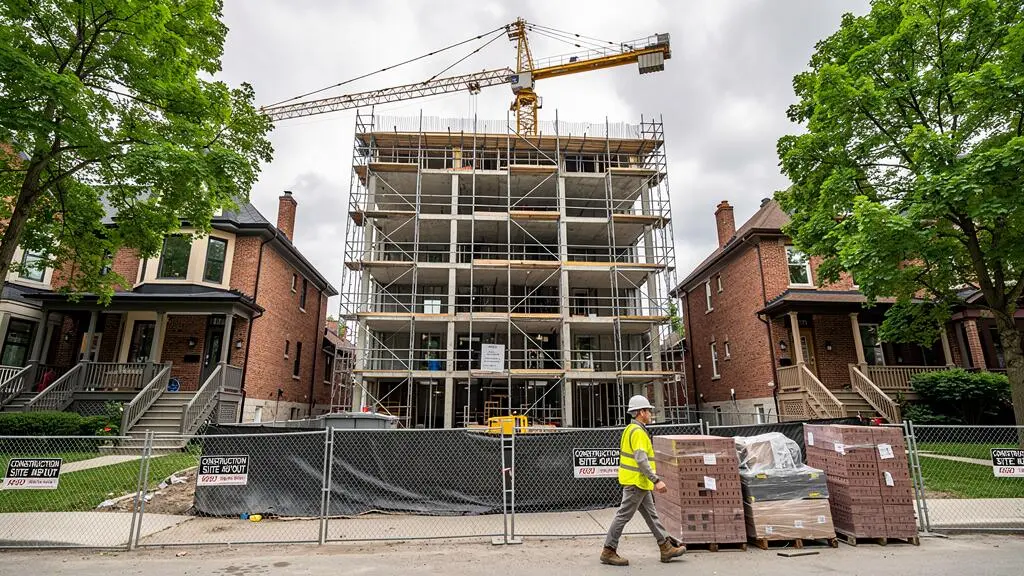
Canada’s housing shortage is not simply a question of whether developers want to build more homes. Housing supply depends on a connected system of developable land, municipal permissions, financing, construction capacity and infrastructure. When one component cannot accommodate additional growth, even strong demand may fail to produce enough completed housing.
The challenge also differs across Canadian markets. An established neighbourhood in Toronto may have strong demand but limited opportunities to assemble viable development sites. A growing suburban municipality may have available land but insufficient water or wastewater capacity. In other locations, approved projects may remain financially unworkable because construction costs exceed expected revenues.
According to the Canada Mortgage and Housing Corporation (CMHC), restoring pre-pandemic housing affordability by 2036 would require substantially more annual construction than Canada’s existing supply system has consistently delivered. Addressing that gap requires more than accelerating permits or opening new land. It requires coordinating development capacity, infrastructure investment and construction decisions before shortages become more severe.
Canada’s housing supply constraints at a glance
- Demand does not guarantee construction. Land costs, financing, approvals and labour capacity can prevent projects from proceeding even when housing prices are high.
- Infrastructure determines where growth is feasible. Available water, wastewater, transportation and other services must support additional homes.
- Faster housing delivery requires coordinated action. Municipalities, provinces, builders and infrastructure providers must align zoning permissions, investment schedules and construction capacity.
- Why Doesn’t High Housing Demand Automatically Lead to More Construction?
- How Can Cities Speed Up Housing Approvals Without Sacrificing Planning Quality?
- Greenfield or Infill Development: Which Can Add Housing Faster?
- What Happens When Housing Growth Outpaces Local Infrastructure?
- When Do Housing Market Conditions Signal a Need for Faster Construction?
- How Can Cities Detect Infrastructure Bottlenecks Before Development Accelerates?
- Mid-Rise or High-Rise Housing: Which Fits Established Neighbourhoods Better?
- Can Urban Infrastructure Keep Up With Growth in Canadian Cities?
Why Doesn’t High Housing Demand Automatically Lead to More Construction?
High housing demand does not automatically increase construction because the supply of new homes responds slowly to market signals. Higher prices may encourage development, but zoning restrictions, land acquisition costs, financing requirements, labour shortages and infrastructure limits can prevent projects from proceeding. Housing demand becomes additional supply only when developers can move viable projects through every stage of delivery.
When more households compete for a limited number of homes, the immediate response is often higher rents, higher purchase prices or stronger competition for existing properties. These changes indicate demand pressure, but they do not establish that new homes can be delivered quickly enough to relieve it.
The housing development process operates through interconnected stages. A builder must identify suitable land, determine permitted density, obtain approvals, secure financing, arrange construction resources and connect the finished development to municipal infrastructure. Delays at one stage can constrain the entire project, regardless of progress elsewhere.
CMHC’s Fall 2026 Housing Supply Report estimates that Canada would need approximately 417,000 to 469,000 homes annually to restore pre-pandemic housing affordability by 2036. This is a modelled requirement under specified assumptions, not a count of completed homes or a binding annual government target.
417,000–469,000 homes annually
CMHC’s estimated annual housing requirement to restore pre-pandemic affordability by 2036. The range reflects a modelled scenario and is sensitive to future economic and housing market conditions.
Canada Mortgage and Housing Corporation, Fall 2026 Housing Supply Report.
High property values can also create a financial paradox. Although higher selling prices may improve expected project revenue, they can raise the acquisition cost of development sites. Where landowners anticipate further appreciation, developers may face asking prices that leave insufficient margins after construction, financing and regulatory expenses.
Even when a project is financially feasible, construction capacity cannot expand instantly. Additional tradespeople, specialized equipment, manufacturing facilities and experienced development teams require sustained investment. Short-term changes in housing starts can occur faster than structural increases in the industry’s productive capacity.
This distinction matters during market downturns. Weak condominium presales or tighter financing may delay construction even when the underlying need for housing remains substantial. CMHC identifies this risk in ownership-oriented development, including Vancouver’s condominium market.
Increasing housing supply therefore requires both viable projects today and a durable development pipeline for future years. Municipal approvals are an important part of that pipeline, but faster approvals must also preserve the planning conditions that make new housing workable.
How Can Cities Speed Up Housing Approvals Without Sacrificing Planning Quality?
Canadian cities can accelerate housing approvals by allowing more development as of right, establishing clear built-form standards and reviewing technical requirements concurrently. Faster decisions do not necessarily require weaker planning rules. The essential distinction is between evaluating whether a proposal meets established standards and repeatedly negotiating standards that could have been determined in advance.
As-of-right zoning allows a development that satisfies applicable requirements to proceed without seeking a discretionary rezoning decision. Where municipalities have already established acceptable building heights, densities, setbacks and permitted uses, developers can design projects around predictable rules rather than negotiate fundamental permissions for each site.
This approach works best when zoning standards are sufficiently detailed to address the surrounding urban environment. Building placement, street-facing design, sunlight access, transitions to neighbouring properties and functional ground-floor uses can be incorporated into regulations before individual applications arrive.
Approval processes can also distinguish between reviews that genuinely depend on one another and those that can proceed in parallel. Transportation assessments, environmental requirements, servicing plans and building design reviews may involve separate municipal departments. Coordinated reviews can reduce administrative waiting periods while maintaining the substantive requirements applied by each department.
According to CMHC’s analysis of housing development timelines, municipal review and approval of multi-unit residential developments takes approximately one year on average in Canada, although timelines vary by municipality and project. Physical construction generally requires another one to two years. These figures illustrate the length of housing delivery, but should not be interpreted as fixed or universally consecutive stages.
A predictable approval framework should provide applicants with documented requirements, identified review responsibilities and clear timelines for decisions or requests for additional information. These measures allow builders to distinguish legitimate design corrections from avoidable procedural uncertainty.
Public participation still matters. Removing consultation without providing an adequate earlier opportunity to address local concerns can shift disputes into later stages. Appeals, redesigns and political opposition may offset the time saved during initial review. Consultation is more useful when it addresses neighbourhood-wide planning choices before individual projects become financially committed to a particular design.
The objective is not the shortest possible review at any cost. It is a process that produces safe, functional development with fewer avoidable delays and clearer accountability.
Once permissions become more predictable, attention shifts to the physical location of new homes. Development on previously undeveloped land and development within existing neighbourhoods face different constraints, making their relative speed highly dependent on local conditions.
Greenfield or Infill Development: Which Can Add Housing Faster?
Infill development can deliver housing faster where existing infrastructure has spare capacity and zoning permits new buildings. Greenfield development can accommodate larger projects on less fragmented sites, but roads, water systems and wastewater networks may need substantial expansion before construction proceeds. Neither approach is universally faster; the determining factor is which land, servicing and approval constraints affect the site.
Greenfield development generally occurs on land that has not previously been urbanized. Larger sites may give developers more flexibility to plan streets, subdivisions and building layouts without working around an established residential fabric. However, that flexibility does not eliminate the need for servicing, environmental assessments or municipal approvals.
Infill development adds homes within existing urban areas through additions, conversions, multiplexes, apartment buildings or redevelopment of underused properties. Its potential advantage is proximity to existing services, employment, schools and transit. Yet the presence of a municipal pipe or road does not establish that the system has sufficient capacity for additional residents.
The trade-offs become clearer when development is compared by stage rather than by overall project size.
| Development factor | Greenfield development | Infill development |
|---|---|---|
| Site planning | May offer flexibility on larger, undeveloped parcels. | Must accommodate surrounding buildings, existing streets and smaller sites. |
| Infrastructure | Often requires new roads, utilities and network extensions. | May use existing systems, subject to verified available capacity. |
| Land assembly | Can involve fewer parcels, depending on ownership. | May require negotiations across multiple property owners. |
| Construction conditions | Can accommodate coordinated, large-scale building programs. | May face constrained access, neighbouring buildings and limited staging space. |
| Housing volume | Can support substantial planned expansions where servicing is available. | Can add homes incrementally across many established neighbourhood sites. |
| Transportation implications | May create greater automobile dependence where transit and destinations are distant. | Can support walking and transit where services and connectivity already exist. |
Land acquisition creates different financial risks. Greenfield developers may need to finance substantial infrastructure before receiving revenue from completed homes. Infill builders may spend significant time negotiating site purchases, resolving access constraints or adapting projects to irregular parcels.
Greenfield construction can deliver large numbers of homes when sites are serviced and approvals are ready. Infill may produce a steadier flow of smaller projects across numerous properties, but annual output depends on how many parcels are financially and technically developable.
A balanced housing strategy should therefore evaluate both opportunities against actual servicing capacity, project feasibility and transportation consequences rather than assume that one development pattern is inherently superior.
In either setting, land availability alone is insufficient. Housing growth becomes difficult when the infrastructure required to support those homes cannot expand at the same pace.
What Happens When Housing Growth Outpaces Local Infrastructure?
When housing growth exceeds local infrastructure capacity, municipalities may restrict new connections, delay development approvals or require expensive system upgrades. Water supply, wastewater treatment, stormwater management, roads and transit all influence how many additional homes an area can accommodate. A development may satisfy zoning requirements yet remain unbuildable or unoccupiable until essential servicing is available.
Infrastructure constraints can create a cascading development problem. If a wastewater treatment facility or sewer network cannot accept additional flows, new housing connections may be limited. Projects that already have zoning approval can then remain stalled while the municipality evaluates upgrades, funding arrangements and construction schedules.
Access to municipal water and wastewater services is particularly important because subdivision clearance, servicing agreements, construction permissions or occupancy approvals may depend on satisfying local requirements. The precise approval stage and applicable rules differ by province, municipality and project type.
Upfront servicing can reduce later uncertainty when capacity deficiencies are known early. Developers and municipalities may coordinate the timing of pipes, pumping facilities or other upgrades with planned construction phases. However, bringing forward infrastructure investment requires suitable financing and agreement over who ultimately bears the costs.
Infrastructure renewal introduces another constraint. Municipalities must maintain existing networks while financing capacity for future development. Deferring maintenance to prioritize new extensions may increase the risk of failures, service interruptions or future restrictions in already developed areas.
The Federation of Canadian Municipalities’ infrastructure overview states that local governments maintain approximately 60% of Canada’s essential infrastructure while receiving about eight cents of every tax dollar collected. These figures reflect the organization’s institutional assessment and advocacy perspective, rather than a municipality-specific engineering audit.
Approximately 60%
Share of Canada’s essential infrastructure maintained by municipalities, according to the Federation of Canadian Municipalities. The figure describes infrastructure responsibilities, not the proportion of infrastructure currently lacking capacity.
Federation of Canadian Municipalities, infrastructure policy overview.
Responsibilities are shared. Developers may finance or contribute to local servicing upgrades through negotiated agreements or applicable development charges. Municipalities can establish infrastructure investment priorities and allocate capacity. Provincial governments can coordinate larger systems and funding arrangements extending across municipal boundaries.
Development cost charges and similar mechanisms can help finance growth-related infrastructure, but they do not replace the engineering assessments required to determine actual capacity. Nor can a financial contribution immediately resolve a shortage if a major facility requires lengthy construction.
Recognizing these constraints before projects are approved is preferable to discovering them after builders have committed capital. Market indicators can also help identify where housing pressure is likely to intensify before those infrastructure decisions become urgent.
When Do Housing Market Conditions Signal a Need for Faster Construction?
Housing markets signal a need for faster construction when demand persistently exceeds the available and anticipated supply of suitable homes. Rising housing costs relative to incomes, low rental vacancies, increasing household crowding and inadequate development pipelines can indicate mounting pressure. These signals should be interpreted together because price increases alone do not establish the size, location or type of additional housing required.
Housing supply analysis must distinguish between a temporary delivery delay and a structural shortage. A temporary delay may occur when projects already under construction are approaching completion. A persistent shortage becomes more likely when future development capacity is inadequate relative to anticipated household formation and changing housing needs.
Several indicators help establish the difference:
- Housing costs relative to incomes: sustained deterioration can indicate that available housing is becoming less affordable, although interest rates and financing conditions also affect ownership costs.
- Rental vacancy: persistently limited availability can signal competition among tenants, particularly when supported by rent and household data.
- Household crowding: increasing numbers of people sharing unsuitable accommodations may reveal housing needs not fully captured by sales activity.
- Housing price-to-rent relationships: substantial divergence may warrant investigation of ownership-market conditions, investor expectations and rental fundamentals.
- Development pipeline: changes in applications, approvals, serviced land inventory and construction starts help indicate the supply likely to arrive in future years.
The timing of these indicators matters. Housing takes time to design, finance, approve and build. Waiting for prices to rise sharply before expanding development capacity can lead to a delayed response, potentially bringing completed homes to market under very different economic conditions.
Market context also changes the interpretation. A city experiencing sustained employment growth and limited rental availability may face a different supply problem from a location where prices rise despite substantial vacant inventory. The latter situation requires investigation of housing suitability, geographic distribution, financing conditions and market composition before treating additional construction volume as the only solution.
Construction decisions should therefore combine present market conditions with forward-looking indicators. Municipalities need to know not only whether housing is expensive today, but whether there is enough approved, financially viable and serviceable housing in the pipeline to accommodate future demand.
The strongest early-warning systems connect market evidence to practical delivery capacity. That requires municipalities to measure infrastructure constraints before additional development overwhelms existing networks.
How Can Cities Detect Infrastructure Bottlenecks Before Development Accelerates?
Cities can detect infrastructure bottlenecks by comparing the housing capacity permitted under zoning with the verified capacity of water, wastewater, stormwater and transportation systems. This requires geographically detailed network assessments, monitoring of existing system performance and realistic projections of additional demand. The resulting capacity map can identify where construction is feasible immediately and where upgrades must be scheduled first.
A citywide infrastructure inventory is useful, but it cannot by itself identify the constraints facing individual developments. A water treatment plant may have available overall capacity while a particular neighbourhood faces insufficient pipe capacity or pressure. Similarly, a sewer system may have spare average capacity but experience problems during peak flows or major rainfall events.
Municipalities can organize capacity assessments by planning district, service area or another geographically appropriate unit. Engineers can then compare existing utilization with additional demand associated with proposed housing, using the relevant design standards and system models.
The central planning question is whether the number of homes legally permitted in an area is consistent with the infrastructure that can actually serve them.
For example, consider a hypothetical district where zoning allows 2,000 additional apartments but the current servicing assessment supports only 800 under the applicable assumptions. The 1,200-unit difference is not proof that those homes can never be built. It identifies a potential servicing gap that must be assessed and addressed before the full zoning capacity can be realized.
Municipal service-capacity dashboards or development screening systems can communicate these constraints earlier. Where such systems are implemented and maintained, they may indicate whether a location has available capacity, requires additional engineering review or depends on a scheduled upgrade. These tools should be treated as preliminary planning information rather than substitutes for project-specific approval.
Useful leading indicators include recurrent sewer surcharge observations, stormwater overflow warnings, pumping-station utilization during peak demand and water-network pressure or flow patterns. Transportation monitoring can similarly reveal growing congestion or transit capacity constraints before they become severe.
These measures require regular updates. Capacity changes when infrastructure is upgraded, additional developments connect, operating conditions change or new engineering assessments become available.
Five actions for an infrastructure-ready housing capacity assessment
- Map existing infrastructure assets. Produce a georeferenced inventory showing water, wastewater, stormwater and major transportation systems across the study area.
- Document current operating constraints. Prepare a capacity register identifying known system limits, recurring performance issues and areas requiring engineering investigation.
- Compare zoning permissions with servicing capacity. Create a district-level table showing permitted housing potential alongside estimated infrastructure-supported capacity and key assumptions.
- Identify required upgrades. Develop a prioritized project schedule listing proposed improvements, dependencies, responsible organizations and preliminary funding requirements.
- Establish a monitoring process. Publish a capacity review schedule and an indicator dashboard that can be updated as new developments connect or infrastructure improvements are completed.
Integrating these assessments with official plans, infrastructure master plans and capital budgets can help municipalities coordinate intensification with service improvements. Capacity thresholds should reflect reliable engineering evidence rather than arbitrary limits on residential density.
Once servicing capacity is understood, planners can make more informed choices about building forms. In established neighbourhoods, the decision between mid-rise and high-rise development affects construction feasibility, land assembly and the number of homes that can realistically be delivered.
Mid-Rise or High-Rise Housing: Which Fits Established Neighbourhoods Better?
Mid-rise housing often fits established Canadian neighbourhoods more easily where parcels are relatively small, streets have a modest scale and incremental redevelopment is possible. High-rise housing can accommodate more homes on individual sites, especially near major transit or employment centres, but usually requires greater capital, specialized construction and suitable infrastructure. The better choice depends on site dimensions, street context and financial feasibility.
Mid-rise buildings of approximately four to six storeys can provide an intermediate form between detached houses and large apartment towers. Depending on applicable building codes, structural design and project characteristics, they may use wood-frame, mass-timber, hybrid or other construction systems.
High-rise projects often rely on more specialized structural systems, vertical transportation, complex construction staging and experienced contractors. Their greater height can support substantial unit counts, but construction logistics and financing demands can make them less suitable for smaller or irregular sites.
The amount of housing delivered across a neighbourhood depends on more than density per building. A series of viable smaller projects may collectively produce meaningful housing growth, while a proposed tower on a difficult site may remain unbuilt for years.
CMHC’s 2025 research on missing-middle housing recorded 31,194 starts across six major Canadian metropolitan areas in 2024, compared with 21,555 in 2023. The study covered Vancouver, Edmonton, Calgary, Toronto, Ottawa and Montréal, and defined missing-middle housing to include building forms of four storeys or less. Its figures therefore cannot be treated as a count of all four-to-six-storey mid-rise construction.
Missing-middle construction in six Canadian metropolitan areas
CMHC examined housing starts for smaller-scale development forms across Vancouver, Edmonton, Calgary, Toronto, Ottawa and Montréal. Its research reported that Calgary and Edmonton together accounted for approximately 67% of missing-middle starts across these six areas in 2024.
CMHC identified relatively abundant land and a lower regulatory burden as factors supporting this development in the two Alberta markets. The findings illustrate how local land conditions and regulation influence smaller-scale construction, without establishing that any single zoning reform caused the observed growth.
Neighbourhood compatibility is another consideration. Building height alone does not determine whether a development fits its surroundings. Street width, building setbacks, upper-floor stepbacks, façade articulation, sunlight exposure and transitions to adjacent properties all influence the experience of a street.
Financial feasibility can nevertheless undermine mid-rise potential. Parking requirements, minimum lot dimensions, setbacks, landscaping obligations and circulation space may consume a large proportion of a small parcel. These constraints can reduce the number of saleable or rentable units below the threshold required to justify redevelopment.
Reviewing such standards can help municipalities assess whether permitted mid-rise housing is actually buildable. Changes should account for safety, accessibility, servicing and neighbourhood conditions rather than merely increase permitted floor area on paper.
High-rise development remains valuable where site characteristics, market demand and infrastructure support it. Mid-rise housing offers a complementary route to distributing additional homes across established communities instead of concentrating most redevelopment opportunities on a limited number of large sites.
The practical objective is to enable building forms that can proceed under real land, financing and construction conditions. Their success ultimately depends on whether urban infrastructure can accommodate the growth they create.
Key takeaways for housing supply planning
- Plan infrastructure and development together. Higher permitted density has limited practical value if essential services cannot support the additional homes.
- Match building forms to viable sites. Smaller infill projects and larger developments can both contribute supply when land, financing and construction constraints are addressed.
- Coordinate investment before shortages intensify. Early capacity assessments and stable capital plans can reduce the risk of approvals becoming disconnected from housing delivery.
Can Urban Infrastructure Keep Up With Growth in Canadian Cities?
Urban infrastructure can keep up with housing growth when municipalities anticipate demand, coordinate land-use decisions with capital investment and secure adequate funding for essential services. Growth becomes harder to accommodate when zoning allows more homes than infrastructure can support or when upgrades are planned only after development pressure emerges. The challenge is primarily one of capacity, financing and coordination.
Canadian municipalities must balance infrastructure expansion against maintenance of existing systems. New housing can require additional water treatment, wastewater capacity, drainage facilities, roads, public transit and utility connections. These investments differ in scale, construction time and the organizations responsible for delivering them.
Municipal financial capacity is an important constraint. Local governments carry substantial infrastructure responsibilities while relying on a limited set of revenue mechanisms relative to the wider federal and provincial fiscal systems. The Federation of Canadian Municipalities emphasizes this mismatch in its infrastructure policy advocacy.
Development charges and other growth-related funding tools can help finance necessary improvements, but their design involves trade-offs. Requiring new development to fund infrastructure may support municipal budgets while increasing upfront project costs. Conversely, relying too heavily on existing municipal revenues can delay projects or shift costs to current residents.
Long-term funding arrangements among federal, provincial and municipal governments can help address large infrastructure needs, particularly when investments serve multiple communities or require lengthy planning and construction periods.
Transportation infrastructure also shapes future housing capacity. Expanding transit service before or alongside residential intensification can increase access to employment and daily services without requiring every additional trip to depend on a private vehicle. Where reliable transit arrives only after substantial growth, communities may develop travel patterns and infrastructure needs that are more difficult to change.
Water, wastewater and energy networks often extend beyond individual municipal boundaries. Regional coordination is therefore essential where upstream facilities, treatment capacity, electricity distribution or transportation corridors serve several jurisdictions. A municipality cannot always expand housing capacity independently when the limiting infrastructure is controlled or financed elsewhere.
A workable housing growth strategy connects three planning decisions:
- Where additional housing should be permitted: prioritize locations with demonstrated demand, appropriate urban form and realistic servicing opportunities.
- When infrastructure improvements must occur: align network expansion, maintenance and transportation investments with projected development activity.
- How construction capacity will be sustained: support a predictable development pipeline that allows builders, workers and suppliers to plan beyond immediate market conditions.
These decisions should be revisited as population patterns, market demand and infrastructure conditions change. A neighbourhood that cannot accommodate substantial growth today may become suitable after a planned upgrade. Another area with apparent capacity may face restrictions as existing infrastructure ages or additional projects connect.
Canada’s housing supply challenge is therefore not solved by choosing between density and infrastructure expansion. Both are necessary, and their timing determines whether new permissions translate into actual homes.
For practical next steps, municipalities and builders can begin by comparing permitted housing capacity with current servicing conditions, identifying the upgrades required for viable projects and aligning future approvals with realistic investment schedules. This approach turns housing targets into a coordinated delivery plan rather than an expectation that construction will automatically follow demand.
What is the difference between housing starts and completed homes?
A housing start indicates that construction has begun, while a completed home has reached the completion stage under the applicable statistical definition. Starts provide information about the construction pipeline but do not measure homes already available for occupancy. The time between these stages varies with project type, scale and construction conditions.
Can municipalities allow more housing without immediately expanding infrastructure?
Yes, where existing infrastructure has verified spare capacity. Municipalities can permit additional development within that capacity while planning future upgrades. However, zoning permissions do not guarantee that an individual project will meet water, wastewater, transportation or other servicing requirements. Engineering assessments remain necessary where system capacity is uncertain.
Why might an approved housing project still not be built?
Approval is only one condition for construction. Developers must also secure financing, meet applicable servicing and permit requirements, obtain suitable contractors and establish that expected revenues justify total project costs. Changes in borrowing conditions, construction expenses or expected sales can delay a project even after municipal planning approval.
Does building more homes automatically make housing affordable?
Additional housing can reduce supply pressure over time, but affordability outcomes depend on the number, location, size, tenure and price of the homes delivered relative to household needs. Construction costs, incomes, financing conditions and the availability of suitable rental or ownership options also matter. Increasing total supply and providing housing affordable to lower-income households are related but distinct policy challenges.
Who is responsible for financing infrastructure needed for new housing?
Responsibility depends on the infrastructure, project and jurisdiction. Municipalities typically manage many local roads and water-related systems, while provincial governments, federal programs, utilities and developers may contribute to particular investments. Development charges, servicing agreements, municipal revenues and intergovernmental funding can all play roles. The applicable rules and financial arrangements vary across Canada.