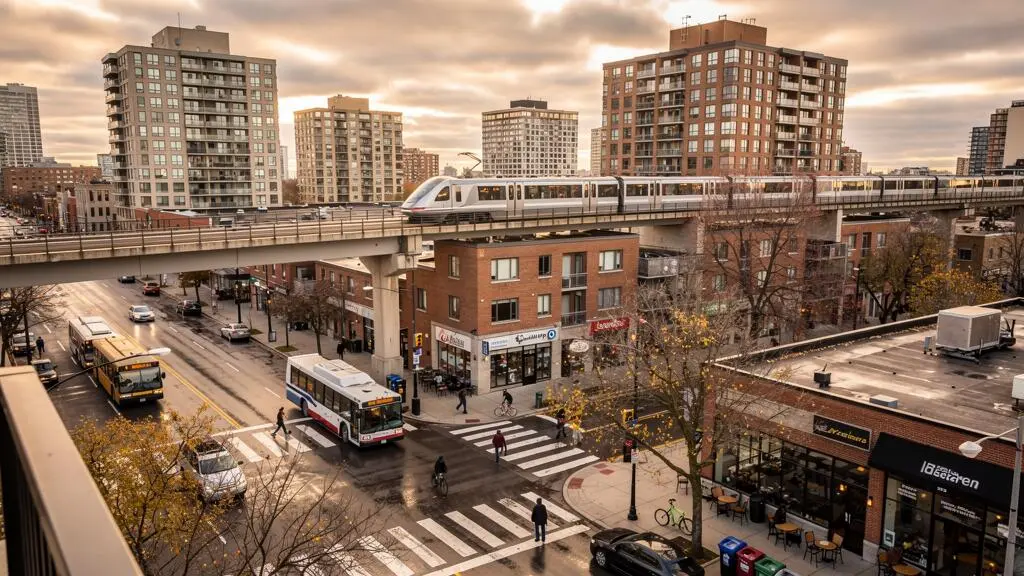
Population density changes how Canadian cities function by concentrating homes, jobs and daily activities within a smaller geographic area. This concentration can make public transit more practical, reduce the distance between essential services and allow infrastructure to serve more residents. It can also increase competition for school places, park space, road capacity and community facilities.
The consequences depend on more than the number of people living in a neighbourhood. Housing types, household sizes, street design, existing infrastructure and the timing of public investment all influence whether additional density improves daily life or creates pressure on local services.
These relationships matter across Canadian communities, from established urban neighbourhoods adding apartments to suburban municipalities accommodating new residential developments. Understanding them helps residents interpret changes around them and gives planners a more useful basis for deciding where growth should occur, which facilities need upgrading and how public spending should be prioritized.
Population density and Canadian cities: key points
- Higher density can make transit and infrastructure more efficient, but schools, parks and other facilities may face capacity constraints.
- Compact development generally allows more households to share infrastructure, while the financial and housing trade-offs depend on local conditions.
- Successful urban growth requires coordinating housing construction with transportation, public services, maintenance and long-term funding.
- Why Does Higher Density Help Some City Services but Pressure Others?
- How Can Growing Neighbourhoods Protect Parks and Shared Public Space?
- Compact or Sprawling Growth: Which Uses Urban Infrastructure More Efficiently?
- When Can Higher Population Density Make Traffic Congestion Worse?
- When Does a Denser Neighbourhood Need More Schools, Parks, or Services?
- How Can Cities Add Density Without Overloading Local Services?
- Centralized or Local Delivery: Which Works Better for Public Services?
- Can Urban Infrastructure Keep Up With Growth in Canadian Cities?
Why Does Higher Density Help Some City Services but Pressure Others?
Higher population density can lower the cost of delivering services when more residents share existing infrastructure. However, it can overwhelm facilities with limited capacity, such as schools, libraries and clinics. The difference depends on whether a service can accommodate additional users efficiently or requires substantial new investment once demand exceeds its available capacity.
Consider two services in the same growing neighbourhood. A transit route may become more productive when additional passengers fill previously underused vehicles. Meanwhile, a nearby elementary school may already have full classrooms. Both services experience increased demand, but their ability to absorb it is fundamentally different.
Network-based services, including transit, water distribution and some waste collection operations, can benefit from economies of scale. More households sharing infrastructure may reduce the amount of network required per resident, provided the system has sufficient capacity.
Capacity-limited services operate differently. Libraries have finite seating and staffing, schools have classroom and enrolment limits, and clinics have a limited number of appointments. When available capacity is exhausted, accommodating additional demand may require expansion, new facilities or operational changes.
A third factor is timing. Housing construction can increase demand before additional facilities are completed. Development-related revenue, municipal budgets and infrastructure investment operate through different administrative and financial processes, so the arrival of residents does not automatically coincide with new service capacity.
Metro Vancouver offers a useful planning example. TransLink’s transit-oriented communities planning guidance recommends concentrating housing, employment and activities near frequent transit while also considering walkability, land-use diversity, street connections and parking management.
The principle is not simply to place more residents near a station. It is to coordinate development with the network and services that residents will use.
A growing population is therefore neither an automatic benefit nor an inevitable burden. The outcome depends on the available capacity, the type of service and how quickly investment responds to demand.
How Can Growing Neighbourhoods Protect Parks and Shared Public Space?
Growing neighbourhoods can protect public space by combining new parkland, improvements to existing parks and more effective use of shared facilities. Municipalities also need to monitor how much accessible green space residents have, not just the total area of parks. Without these measures, population growth can reduce available park space per person even when no park is physically removed.
Suppose a neighbourhood has an established park network and its residential population increases substantially. The parks may retain their original boundaries, yet more people now share the same lawns, playgrounds, paths and sports facilities.
This creates two related pressures: less space available per resident and greater use of park infrastructure. Neither can be understood by looking at total green area alone.
Toronto illustrates an approach to measuring these changes. The City of Toronto’s Parkland Strategy assesses parkland availability in square metres per person and identifies neighbourhoods where additional green space or improvements should be prioritized.
13%
Approximately 13% of Toronto’s land area is covered by parks, according to the City’s Parkland Strategy materials. This citywide proportion does not indicate whether individual neighbourhoods have equitable access to usable green space.
City of Toronto, Parkland Strategy.
Protecting access requires several complementary approaches:
- Acquiring new parkland: reserve or purchase sites where population growth will increase demand.
- Securing developer contributions: use applicable parkland dedication requirements or cash-in-lieu arrangements to support municipal park planning.
- Improving existing spaces: upgrade playgrounds, seating, paths and recreational facilities to accommodate different activities.
- Connecting public spaces: improve pedestrian routes between parks, schools and other accessible outdoor areas.
- Sharing underused spaces: explore permitted use of schoolyards, temporary pedestrian areas or other public property outside their primary operating periods.
Shared use depends on ownership, safety, accessibility and operating agreements. A schoolyard, for example, cannot be assumed to be publicly accessible simply because it is empty outside school hours.
Maintenance deserves equal attention. Higher foot traffic can increase wear on turf, paths and equipment. A neighbourhood may therefore need a larger maintenance budget even when acquiring additional land is not feasible.
As development becomes more compact, protecting shared outdoor space is essential to preserving the benefits of neighbourhood life. The next question is how that compactness affects the wider infrastructure network.
Compact or Sprawling Growth: Which Uses Urban Infrastructure More Efficiently?
Compact growth generally allows more households to share each kilometre of road, water main, sewer and other infrastructure, potentially reducing costs per resident. Sprawling growth typically requires longer networks to serve dispersed homes. However, infrastructure efficiency must be assessed alongside construction costs, long-term maintenance, housing choices and the capacity of existing systems.
The distinction becomes clearer when considering the amount of infrastructure required to serve different development patterns.
In a compact neighbourhood, many homes may connect to the same relatively short section of road and municipal utility network. In a low-density subdivision, the same number of households may require a larger geographic network of streets, pipes, sidewalks and service routes.
Those networks create ongoing responsibilities. Roads need resurfacing, pipes eventually require rehabilitation, and public spaces need maintenance. Canadian winters also make snow clearing and seasonal infrastructure upkeep important municipal considerations.
Construction cost is only one part of the equation. A new development should also be evaluated against the cost of operating, maintaining and eventually replacing the infrastructure it requires.
Statistics Canada’s research on urban sprawl and densification, published in May 2024, examined residential development from 2016 to 2021. Its findings show how development patterns differ across Canadian metropolitan areas and how established urban locations can offer greater proximity to jobs and transit than newly developed sprawling areas.
18.3 times
In Statistics Canada’s analysis, the public-transit proximity index within Toronto’s established population centres was 18.3 times the index for areas classified as urban sprawl. This compares proximity indices, not travel times, ridership or infrastructure expenditures.
Statistics Canada, 2024 analysis of residential development using 2016–2021 data.
Compact development is not universally cheaper to build. Projects in established neighbourhoods may involve expensive land, utility upgrades, site constraints and complex construction. Outlying development may offer larger lots and different housing products, but households may face greater transportation expenses when daily destinations are farther away.
The comparison therefore needs more than a simple density figure.
| Planning criterion | Compact growth | Sprawling growth |
|---|---|---|
| Road and utility networks | More households may share shorter networks | Longer networks may be required per household |
| Long-term maintenance | Potentially lower network requirements per resident, subject to capacity | More dispersed assets may increase maintenance obligations |
| Daily destinations | Greater potential for nearby services and walking trips | Longer trips may be necessary where uses are separated |
| Housing considerations | Existing land values and redevelopment costs can be significant | More land per dwelling may be available, with transportation trade-offs |
| Infrastructure constraints | Older networks may require upgrades | New networks often need to be constructed and maintained |
For a practical comparison, residents and municipal planners can examine road length per household, proximity to everyday services and the transportation modes available for common trips. A complete financial assessment would also include local construction and lifecycle cost estimates.
The financially preferable development pattern will vary by location. What matters is understanding the full cost of providing and sustaining services rather than focusing only on the initial housing project.
When Can Higher Population Density Make Traffic Congestion Worse?
Higher population density can worsen congestion when additional residents generate more vehicle trips than the surrounding road network can accommodate. However, density does not automatically produce traffic jams. Neighbourhoods with frequent transit, connected streets, walkable destinations and effective parking management can accommodate more people without a proportional increase in private-car travel.
The important distinction is between population growth and vehicle demand. More residents create more potential trips, but those trips do not all have to be made by car.
A neighbourhood containing housing, groceries, schools and frequent transit offers residents multiple transportation choices. A similarly dense residential area separated from jobs and essential services may generate greater pressure on roads if driving remains the most practical option.
Congestion becomes particularly challenging where transportation alternatives are limited. Busy intersections, constrained arterial roads, railway crossings and concentrated employment destinations can create bottlenecks that affect a wider network.
Parking policy also shapes travel behaviour. Providing abundant, convenient parking can make driving more attractive, while appropriately managed parking combined with practical transportation alternatives can reduce car dependence.
Transit-oriented planning addresses these relationships together. TransLink’s guidance for Metro Vancouver emphasizes density, destination accessibility, connected pedestrian environments, diverse land uses and demand management as complementary elements of effective transit communities.
Road expansion is not necessarily a permanent solution. When additional road capacity makes driving more convenient, it can attract or enable more vehicle trips, a phenomenon known as induced demand. Its magnitude depends on local circumstances, but the possibility means road widening should be evaluated against longer-term travel behaviour.
Planners should therefore investigate whether local congestion results from insufficient transit service, intersection design, through traffic, parking arrangements or the distribution of destinations before attributing it solely to new housing.
A neighbourhood’s transportation performance is ultimately determined by how people can move through it, not simply by how many people live there. Public facilities face a similar challenge of matching demand to available capacity.
When Does a Denser Neighbourhood Need More Schools, Parks, or Services?
A denser neighbourhood needs additional schools, parks or public services when projected demand approaches or exceeds the practical capacity of existing facilities. The threshold depends on population characteristics, catchment areas, accessibility and service standards. Population density alone cannot determine which facilities are needed because households of similar size and location may generate different demands.
Many public facilities have capacity constraints that become especially visible during rapid growth. An elementary school may absorb a moderate increase in enrolment but struggle when additional students exceed available classroom space. A community centre may accommodate new members until its most popular programs reach full enrolment.
These pressures do not necessarily increase in a smooth, predictable line. An additional residential phase can push an existing facility past a threshold requiring expansion or a new location.
Household composition matters as much as dwelling count. A building occupied primarily by smaller adult households may generate different service demands than a development with many families and school-aged children.
Similarly, neighbourhoods with larger older-adult populations may need accessible healthcare, community programming and transportation services that differ from those required by younger families.
Canadian municipalities and service providers can anticipate these differences through population projections, neighbourhood assessments, infrastructure planning and coordination with relevant institutions. School boards may evaluate projected enrolment, while municipal departments assess parks, recreation facilities and other services within their responsibilities.
A practical hypothetical example illustrates the problem. Imagine a new townhouse development beside a school operating close to capacity. If the development attracts many families, enrolment demand may rise quickly. Adding temporary classrooms could address some immediate pressures, but it would not automatically solve longer-term space requirements or related needs such as playground capacity.
By contrast, an apartment development with relatively few children might have a smaller effect on enrolment while increasing demand for other facilities.
For planning purposes, the key indicators include projected population by age, school enrolment relative to usable capacity, park access, facility usage and the time required to expand services.
When these assessments occur early, municipalities and service providers have more opportunities to coordinate investment with construction. That coordination becomes particularly important when deciding how to add housing within established communities.
How Can Cities Add Density Without Overloading Local Services?
Cities can add density without overloading services by identifying existing capacity, directing development toward suitable locations and planning facility upgrades alongside housing. Smaller-scale additions can sometimes be absorbed gradually, while larger projects may require coordinated investment. The essential approach is to assess water, transportation, schools, parks and community facilities before demand exceeds their practical limits.
One strategy is gentle density: adding housing through secondary suites, duplexes, townhouses or small apartment buildings within established residential areas.
These housing forms can distribute population growth across existing neighbourhoods rather than concentrating every new household in a single large development. However, gentle density is not automatically capacity-neutral. Its cumulative impact still needs to be evaluated.
Another approach focuses higher-density housing around established or planned transit corridors and urban centres. These locations may offer better access to employment and services, provided existing systems can accommodate additional users or planned upgrades are delivered.
Infrastructure capacity should be checked at several levels. A municipal water system may have adequate overall supply while a particular pipe or pumping facility creates a local constraint. Similarly, transit service may be available along a corridor but already crowded at peak periods.
The planning sequence matters: forecast demand, evaluate available capacity, identify necessary upgrades, coordinate funding and establish when improvements must be operational.
Five checks before approving neighbourhood growth
- Map the proposed population increase: produce a neighbourhood forecast identifying expected residents, households and relevant age groups.
- Review existing service capacity: prepare a capacity table covering schools, transit, parks, water and community facilities, noting missing information.
- Identify critical constraints: produce a register of facilities where projected demand may exceed available capacity.
- Coordinate required improvements: prepare a delivery schedule identifying responsible organizations, funding dependencies and intended completion stages.
- Establish monitoring indicators: create a dashboard tracking actual population growth, service demand and the status of planned improvements.
Municipalities can use development-related funding arrangements, capital planning and agreements with relevant partners to support growth-related infrastructure. The mechanisms vary by province and service type, so each project requires a review of applicable responsibilities and legislation.
In Toronto, for example, the City’s development charges information explains how charges collected from developers help fund infrastructure required to serve growth, including roads, transit, water systems and community facilities.
These charges are not a guarantee that all infrastructure needs will be financed or completed before residents arrive. Planning must account for remaining funding requirements and delivery timelines.
Adding housing successfully requires collaboration across organizations responsible for different services. It also raises a broader question: which services should be distributed throughout neighbourhoods, and which work better when concentrated in fewer locations?
Centralized or Local Delivery: Which Works Better for Public Services?
Neither centralized nor local delivery is universally better for public services. Centralized facilities can concentrate specialized staff, equipment and resources, while neighbourhood facilities improve proximity and convenience. Higher density often makes local services easier to sustain because more residents can access them within a relatively small area. An effective urban service network typically combines both approaches.
Centralization can be appropriate when a service requires expensive equipment, specialized expertise or facilities that cannot be economically duplicated across multiple neighbourhoods.
Specialized hospital care is one example. Concentrating expertise and equipment may support services that would be difficult to provide at every local facility.
Local delivery serves a different purpose. Neighbourhood libraries, community centres and accessible primary-care services can reduce the distance residents must travel for routine needs.
Density changes the potential user base. A local library branch in a compact neighbourhood may have more residents within walking distance than an otherwise comparable branch serving dispersed households.
However, a larger potential user base does not automatically guarantee adequate funding, staffing or space. Service quality still depends on resources and operating conditions.
| Criterion | Centralized delivery | Local delivery |
|---|---|---|
| Access | May require longer journeys | Can reduce travel for nearby residents |
| Specialized resources | Can concentrate expertise and equipment | May have a narrower range of services |
| Operating efficiency | Can consolidate costly functions | May serve frequent everyday needs efficiently in dense areas |
| Neighbourhood presence | Serves a larger geographic catchment | Supports direct access and local relationships |
| Best suited to | Complex or specialized functions | Routine, accessible and community-oriented services |
Canadian service networks often reflect this combination. In Quebec, local community service centres, known as CLSCs, form part of the health and social services system, while specialized medical services are organized through other facilities. Elsewhere, community health centres and neighbourhood libraries illustrate different forms of local access.
Population density can also improve the efficiency of some mobile services. Home visits, meal delivery and certain collection services may require shorter distances between destinations in compact communities, although traffic, building access and staffing still affect actual performance.
Service planners should therefore examine who needs a service, how frequently it is used, whether specialized resources are required and how easily residents can reach the facility.
The resulting network should reflect different types of demand rather than imposing a single delivery model. Coordinating these choices becomes more difficult as urban populations grow and infrastructure needs compete for limited resources.
What matters for future urban growth
- Assess usable infrastructure capacity before directing substantial housing growth toward a neighbourhood.
- Compare the full lifecycle cost of infrastructure with the funding available to build, operate and maintain it.
- Coordinate transportation, housing and public facilities across responsible institutions instead of planning each system independently.
Can Urban Infrastructure Keep Up With Growth in Canadian Cities?
Canadian urban infrastructure can keep up with population growth when governments plan capacity early, coordinate investment and direct development toward locations that can support it. The challenge is that housing, transportation, water systems and public facilities operate on different funding and construction timelines. Growth becomes harder to manage when new residents arrive before essential infrastructure is ready.
Housing can be added to an established neighbourhood while major infrastructure improvements remain in planning, funding approval, design or construction. Transit extensions, water treatment facilities and new schools can involve complex processes and multiple responsible organizations.
The resulting delays are not always caused by an absence of long-term planning. They may also reflect financing constraints, construction complexity, land availability, regulatory requirements and coordination between public institutions.
Funding is fragmented across different responsibilities. Municipalities rely on mechanisms that can include property taxes, user charges and development-related contributions, while provincial and federal governments may support particular infrastructure programs.
Municipal revenue sources and borrowing arrangements vary across Canada. Development charges can help fund eligible growth-related infrastructure in jurisdictions where they apply, but they do not automatically cover every capital or operating requirement.
Existing infrastructure also competes for funding. A city must decide how much to invest in new capacity while maintaining roads, pipes, transit assets and public facilities already serving residents.
This makes preventive maintenance an important part of growth management. Delaying upkeep can create future service disruptions and replacement pressures, even where new infrastructure projects receive greater public attention.
Four planning priorities can help municipalities manage the relationship between growth and infrastructure:
- Direct suitable new housing toward locations with available or realistically expandable infrastructure capacity.
- Coordinate transit, walking access and essential facilities with projected housing occupancy.
- Establish financing arrangements that identify both capital investment and future operating responsibilities.
- Monitor actual demand and maintain existing systems while updating long-term infrastructure plans.
Residents can also evaluate proposals more effectively by asking specific questions. How many additional households are expected? Which services have spare capacity? What improvements are needed? Who is responsible for delivering them, and how will their progress be monitored?
These questions are more informative than treating density itself as evidence that a proposal will succeed or fail.
Canadian communities do not all face the same constraints. Established urban neighbourhoods may need network upgrades and better public-space management, while newly developing areas may require entire service networks. Differences in geography, climate, demographics and municipal finances further shape the options available.
For the next neighbourhood development or municipal growth proposal, start by comparing expected population changes with documented service capacity and funded infrastructure plans. That provides a practical basis for identifying gaps, asking informed questions and prioritizing improvements before they become urgent.
Is population density the same as overcrowding?
No. Population density measures how many people occupy a defined area, while overcrowding describes conditions in which available space is insufficient for the people using it. A dense neighbourhood can function comfortably when housing, transportation and public facilities are appropriately designed and managed. Overcrowding may occur in individual homes or facilities even within a relatively low-density community.
Can low-density Canadian communities support good public services?
Yes. Low-density communities can provide effective public services, but their delivery models may differ from those of compact urban neighbourhoods. Greater distances between households can affect transportation, infrastructure maintenance and the economics of maintaining numerous local facilities. Service quality depends on funding, organization, accessibility and community needs, not density alone.
How is population density usually measured?
Population density is commonly expressed as residents per square kilometre or per hectare. The selected geographic boundary matters: a citywide average can conceal substantial differences between residential neighbourhoods, commercial districts and undeveloped land. Planners may also examine dwelling density and the combined concentration of residents and jobs to understand infrastructure demand more accurately.
Does building taller apartment buildings automatically improve transit?
No. Additional homes can increase the potential number of transit users, but successful service also depends on route frequency, reliability, station access, connectivity and the location of daily destinations. TransLink’s transit-oriented communities guidance treats density as one component of a broader approach that includes pedestrian design, land-use diversity and demand management.
What should residents check when major development is proposed nearby?
Residents can review the projected number and types of households, school capacity, transit access, available parkland, utility constraints and proposed infrastructure improvements. It is also useful to identify which organization is responsible for each service, whether funding has been confirmed and how planned improvements relate to the expected occupancy of new housing. These details help distinguish manageable growth from unresolved service pressures.